Best Air-Dried Dog Food for Boston Terriers: How It Compares to Kibble
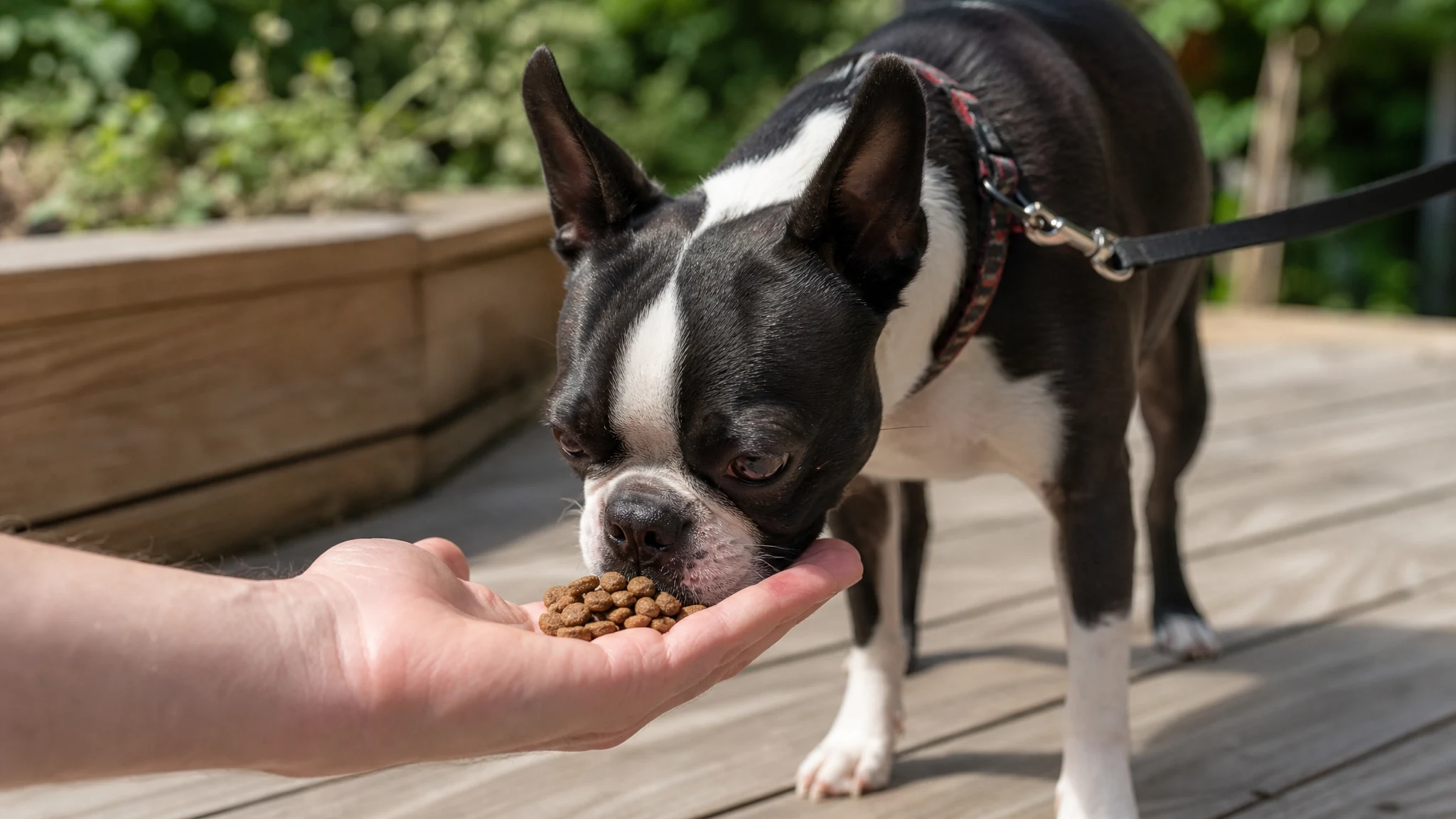
General nutrition information compiled from product labels and published sources, not veterinary advice. Your veterinarian is the right person to choose a diet for your dog, especially one with a health condition.
Air-dried foods are often sold as a step up from kibble. That is a marketing story, not a nutrition measurement. This guide shows you how to judge the best air dried dog food for Boston Terriers using the same label checks you would use on any bag of kibble.
We compared label data from brand pages. We did not run feeding trials or taste tests, and we did not feed any of these foods to dogs. No air-dried product is compared by name below. The label data we could verify covers kibble and a few other formats, so check each air-dried brand's own page for its numbers.
Why the label matters more than the format
Boston Terriers are small. The AKC weight classes, as summarized by Wikipedia, run from under 15 lb to 25 lb. That puts the whole breed inside the range that small-breed formulas from Hill's Science Diet (up to 25 lb) and Royal Canin cover.
Weight control is a practical concern for this breed. A Vet Times report on a PLOS One study found that 62.5 percent of 104 tested Boston Terriers had some grade of brachycephalic airway obstruction (BOAS). The report said the breed showed less severe BOAS than English or French Bulldogs. Food does not treat BOAS. A veterinarian decides what is right for an individual dog, including a healthy body weight.
What you need before you compare
- The bag or product page for each food, including the small print.
- Your dog's current weight and age.
- A calculator or notes app for calories per day.
- The name of your veterinarian, for a final check on the choice.
Step-by-step: compare an air-dried food with kibble
Step 1. Find the AAFCO statement
Look for the sentence that says the food is formulated to meet AAFCO Dog Food Nutrient Profiles, or that feeding tests substantiate it. It should name a life stage: growth, maintenance, or all life stages.
Royal Canin Small Adult, for example, says it is formulated to meet AAFCO nutrient levels for maintenance. The Merrick Kitchen Comforts Small Breed page we reviewed shows no adequacy statement. If a page is missing one, check the bag or ask the brand. A food without a complete and balanced statement is not a safe everyday base diet.
Step 2. Match the life stage
Puppies need a growth or all-life-stages statement. Adults need maintenance or all life stages. Because Boston Terriers stay under 70 lb, the AAFCO phrase about large-size dogs does not narrow the choice. Whole Dog Journal explains that AAFCO treats 70 lb or more as large-size. When an adult age is unclear for your dog, ask your veterinarian.
Step 3. Read the first ingredients
The first five ingredients show what the recipe leans on. Treat them as a snapshot, because lists can change by bag. A named meat first is not a quality guarantee, and ingredients like corn or rice are not automatically bad. They are simply facts to weigh with your veterinarian.
Step 4. Compare protein and fat on the same basis
This is where air-dried and kibble comparisons go wrong. Some labels give as-fed minimums. Others, like Hill's, publish average nutrient content on a dry matter basis. Dry matter numbers look higher because the water is removed. Never set one next to the other without noting the basis.
Air-dried foods have little moisture, so their as-fed numbers may sit closer to dry matter figures. Check which basis the brand uses.
Step 5. Compare calories per cup or per kilogram
Calories decide how much goes in the bowl. A denser food means a smaller portion. Compare kcal per cup, and kcal per kilogram if given, then work out daily amounts.
Step 6. Use the feeding guide as a starting point
Hill's Science Diet Adult Small & Mini suggests 1 1/3 cups per day for a 15 lb dog and 1 2/3 cups for a 20 lb dog. Those are label guides, not prescriptions. Watch your dog's body condition and adjust with your veterinarian.
Step 7. Check the brand page for the air-dried food
Repeat steps 1 to 6 for any air-dried product you are considering. If the page leaves out the AAFCO statement, calories or a guaranteed analysis, treat that as a reason to contact the brand before buying.
Kibble label data for reference
Here is the label data from the brand pages we reviewed. Use it as a benchmark when you read an air-dried label.
| Food | AAFCO life stage | Protein | Fat | Calories per cup | First ingredients |
|---|---|---|---|---|---|
| Royal Canin Small Adult (dry) | Maintenance | 25% min | 14% min | 359 kcal | Corn, chicken by-product meal, brewers rice, brown rice, corn protein meal |
| Royal Canin Small Puppy (dry) | Growth | 29% min | 18% min | 349 kcal | Chicken by-product meal, brewers rice, chicken fat, wheat gluten, corn |
| Hill's Science Diet Adult Small & Mini Chicken & Brown Rice (dry) | Maintenance (feeding tests) | 25% (dry matter average) | 15.3% (dry matter average) | 357 kcal | Chicken, brown rice, whole grain wheat, whole grain corn, brewers rice |
| Hill's Science Diet Adult 7+ Small & Mini (dry) | Maintenance (feeding tests) | 21.5% (dry matter average) | 15% (dry matter average) | 359 kcal | Chicken, brown rice, whole grain wheat, whole grain corn, brewers rice |
| Merrick Kitchen Comforts Small Breed Chicken & Brown Rice (dry) | No statement on page | 27% min | 16% min | 467 kcal | Chicken, chicken meal, brown rice, barley, oatmeal |
Two cautions. The Hill's numbers are dry matter averages, not as-fed minimums. And Merrick's calorie figure is much higher per cup than the others, so a cup of it is not a cup of Royal Canin. Portions must be set per food.
None of these is made specifically for Boston Terriers. They are small-breed or size-based formulas. We found no breed-specific formula confirmed for any brand.
Tips
- Compare calories first, then protein and fat. Calories drive weight.
- Change foods gradually over several days, and ask your veterinarian about the pace.
- Measure portions with a cup or kitchen scale rather than guessing.
- Treats and toppers count toward daily calories.
- For suspected food allergy, work with a veterinarian. One fresh-food company, Nom Nom, says corn and soy are the main triggers and suggests an 8 week single-ingredient trial. That is a commercial claim, not clinical evidence.
Common mistakes to avoid
- Comparing different bases. Dry matter against as-fed numbers misleads.
- Trusting the format. Air-dried, fresh, or kibble is a processing description. The AAFCO statement and the label data tell you more.
- Assuming grain-free is safer. The FDA's investigation into diets and canine dilated cardiomyopathy (DCM) last posted an update on December 23, 2022. The FDA said adverse event reports alone do not establish causation, and it does not plan more public updates without meaningful new science. Ask your veterinarian about heart concerns.
- Feeding the same volume after a switch. Calorie density can differ a lot between foods.
- Treating a price or review as a nutrition fact. Neither is a label measurement.
What to expect
If you compare labels this way, you will probably end up with a clearer view of what each food offers and what it leaves out. You may find an air-dried food that fits your dog's life stage and calorie needs. You may find the kibble you already feed holds up well. Results vary by dog, and no food is guaranteed to change coat, energy, digestion or weight. Watch your dog over several weeks and share changes with your veterinarian.
For a wider look at the label data we gathered, see our label-based comparison of dog foods for Boston Terriers.
Sources
- Royal Canin Small Adult (dry)
- Royal Canin Small Puppy (dry)
- Hill's Science Diet Adult Small & Mini
- Hill's Science Diet Adult 7+ Small & Mini
- Merrick Kitchen Comforts Small Breed Chicken & Brown Rice
- Nom Nom, Boston Terrier skin allergies article
- FDA, investigation into diets and canine dilated cardiomyopathy
- Vet Times, Boston Terrier brachycephaly analysis
- Wikipedia, Boston Terrier
- Whole Dog Journal, large breed puppy food