Best Chicken-Free Dog Food for Boston Terriers: Label-Based Options
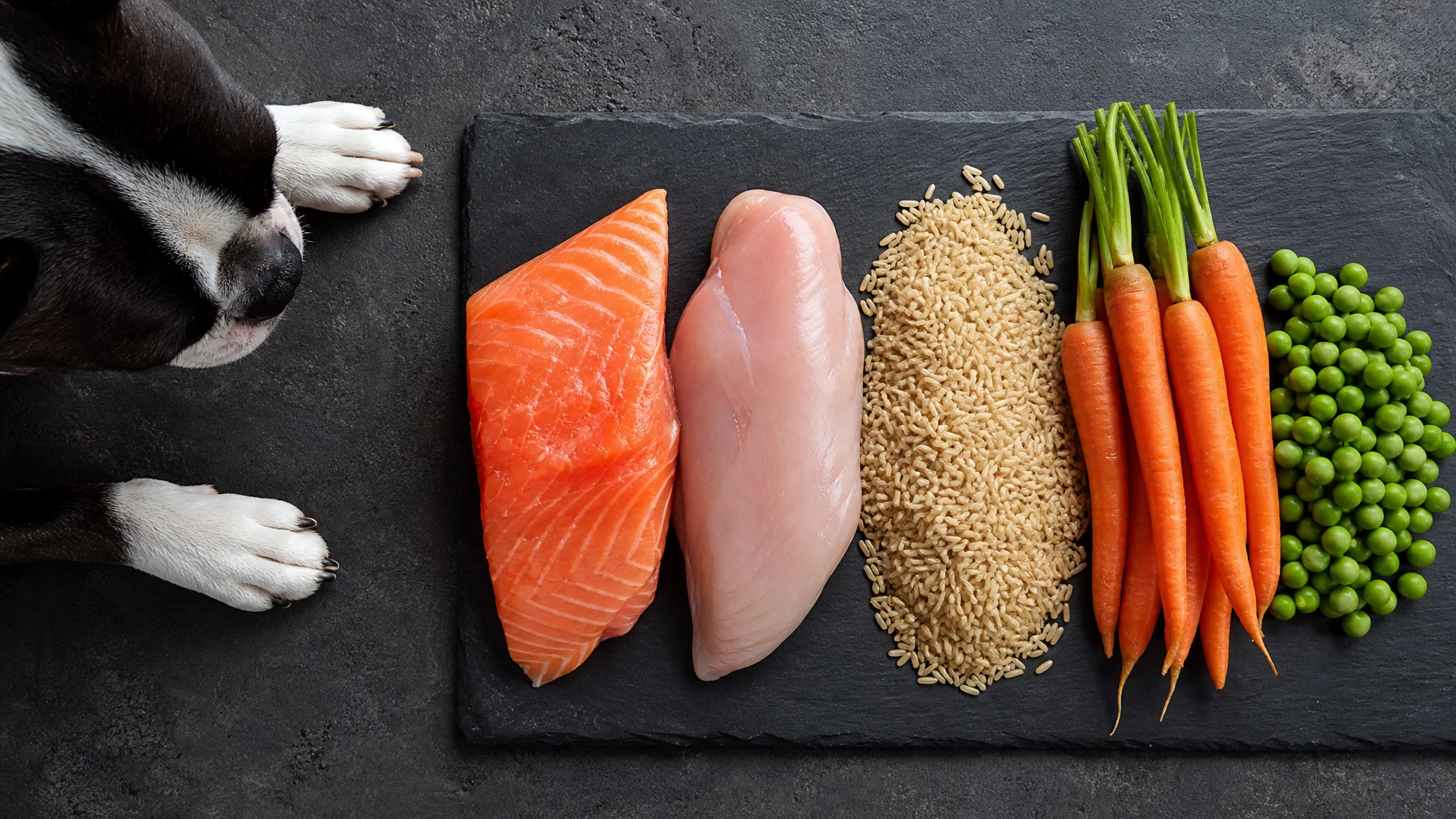
General nutrition information compiled from product labels and published sources, not veterinary advice. Your veterinarian is the right person to choose a diet for your dog, especially one with a health condition.
Finding the best chicken-free dog food for Boston Terriers is mostly a label-reading job. Chicken shows up in many places on an ingredient panel, and a front-of-bag claim does not tell you much.
This guide walks through how to check a label for chicken, how to compare what is left, and what to ask your veterinarian first. We also checked the label data for several well-known small-breed foods. Here is the plain result: none of them is chicken-free.
How we compared: label data only
We compared label data published on each brand's own product page. That means the AAFCO statement, life stage, protein, fat, calories per cup and the first five ingredients.
We did not run feeding trials or taste tests. We are not claiming how any food performs in a real dog. The comparison tells you what is printed on the label, nothing more.
Materials you will need
- The full ingredient list for each food you are considering. The first five ingredients are only a start.
- Your dog's current weight and life stage (puppy, adult or senior).
- A note of any reactions your veterinarian has already linked to a food.
- A pen and paper, or a phone note, to record each food's data side by side.
Step 1: Talk to your veterinarian before dropping chicken
Chicken-free is a feeding choice, not a diagnosis. Boston Terriers are listed with skin conditions such as atopic dermatitis, according to Wikipedia. Itching can have many causes, and only a veterinarian can sort them out for an individual dog.
One fresh-food company, Nom Nom, says corn and soy are the main food triggers in the breed. It also recommends an 8 week single-ingredient food trial. That is a commercial claim, not clinical evidence. If a trial diet makes sense for your dog, your veterinarian should set it up.
No food on this page is a treatment for any skin, gut or other condition. Prescription diets are something only a veterinarian prescribes.
Step 2: Confirm the right life stage and size
Boston Terriers are small. Wikipedia, summarizing the AKC standard, lists weight classes under 15 lb, 15 to 20 lb and 20 to 25 lb. That fits small-breed formulas.
AAFCO's large-size cutoff is 70 lb as an adult, according to Whole Dog Journal. A Boston Terrier is far below it. So the wording 'growth including growth of large size dogs' on a puppy food does not rule a food out for this breed.
When an adult becomes a senior can differ by dog. We did not find a firm age for this breed, so ask your veterinarian.
Step 3: Find the AAFCO statement
Look for a sentence saying the food is formulated to meet, or has been shown by feeding tests to meet, the AAFCO nutrient profiles for a life stage. Royal Canin Small Adult, for example, says it is formulated to meet the AAFCO Dog Food Nutrient Profiles for maintenance.
Hill's Science Diet Adult Small & Mini says that animal feeding tests using AAFCO procedures substantiate complete and balanced nutrition for maintenance of adult dogs.
We did not find an AAFCO adequacy statement on the Merrick Kitchen Comforts Small Breed page. Check the bag or ask Merrick before you rely on it as a complete diet.
Step 4: Read the whole ingredient list for chicken
Do not stop at the word 'chicken.' Scan for all of these:
- Chicken, chicken meal and chicken by-product meal
- Chicken fat
- Poultry fat or poultry meal
- Chicken broth, chicken flavor or similar flavorings
If a term is unclear, ask the brand directly. Also ask whether chicken is handled on shared equipment, since a label rarely says.
What the label data shows for foods we checked
These are the first five ingredients as shown on each brand's page. They can change by bag, so confirm on yours. Hill's publishes average nutrient content on a dry matter basis, which is not the same as the as-fed minimums on the other labels, so we list it separately.
| Food | First five ingredients | Chicken-free? |
|---|---|---|
| Royal Canin Small Adult (dry) | Corn, chicken by-product meal, brewers rice, brown rice, corn protein meal | No |
| Royal Canin Small Puppy (dry) | Chicken by-product meal, brewers rice, chicken fat, wheat gluten, corn | No |
| Royal Canin Canine Health Nutrition Beauty Adult Loaf in Sauce (wet) | Water, chicken, pork by-products, pork liver, corn meal | No |
| Hill's Science Diet Adult Small & Mini Chicken & Brown Rice (dry) | Chicken, brown rice, whole grain wheat, whole grain corn, brewers rice | No |
| Hill's Science Diet Puppy Small & Mini Chicken & Brown Rice (dry) | Chicken, whole grain oats, brown rice, chicken meal, chicken fat | No |
| Nom Nom Chicken Cuisine (fresh) | Chicken, sweet potatoes, squash, spinach, fish oil | No |
| Merrick Kitchen Comforts Small Breed (dry) | Chicken, chicken meal, brown rice, barley, oatmeal | No |
We also checked the Hill's Adult 7+ Small & Mini formula. It lists chicken first as well.
The Royal Canin formulas are small-breed size formulas, not Boston Terrier specific. We did not confirm a breed-specific formula from any brand.
Nutrient and calorie data for comparison
Use this table to see how the numbers compare once you have found a chicken-free candidate. Protein and fat are label minimums unless marked.
| Food | Protein | Fat | Calories |
|---|---|---|---|
| Royal Canin Small Adult | 25% min | 14% min | 359 kcal per cup |
| Royal Canin Small Puppy | 29% min | 18% min | 349 kcal per cup |
| Hill's Adult Small & Mini | 25% dry matter average | 15.3% dry matter average | 357 kcal per cup |
| Hill's Puppy Small & Mini | 28.9% dry matter average | 19.7% dry matter average | 418 kcal per cup |
| Merrick Kitchen Comforts Small Breed | 27% min | 16% min | 467 kcal per cup |
| Nom Nom Chicken Cuisine | 6.5% min | 4.5% min | 244 kcal per cup |
Fresh and wet foods contain a lot of water, so their percentages look low next to dry food. Compare them on calories, not on the raw percentage.
Step 5: Use calories and the feeding guide as a starting point
Calories per cup vary a lot, from 244 to 467 in the table above. A cup of one food is not a cup of another. Weight control matters for breathing in flat-faced dogs, so portion size is worth getting right.
A Vet Times report on a PLOS One study found that 62.5 percent of 104 tested Boston Terriers had some grade of brachycephalic airway obstruction. Your veterinarian can tell you what a healthy weight looks like for your dog.
Feeding guides are starting points. For example, Hill's Adult Small & Mini lists 1 1/3 cups per day for a 15 lb dog and 1 2/3 cups for a 20 lb dog. Adjust with your veterinarian, based on body condition.
Step 6: Switch slowly and keep notes
Mix a little of the new food into the old and shift the ratio over about a week or more. Note stool, itching and appetite in a simple log. Share it with your veterinarian.
Tips and common mistakes
- Mistake: assuming a 'beef' or 'salmon' flavor name means no chicken. Read the ingredients.
- Mistake: trusting only the first five ingredients. Chicken fat can appear lower down.
- Mistake: treating grain-free as chicken-free or as safer. They are different questions. The FDA's page on its dilated cardiomyopathy investigation says adverse event reports alone do not establish causation. Its last update there is dated December 23, 2022.
- Tip: keep treats and chews chicken-free during any food trial, or the result will be unclear.
- Tip: ask the brand for the complete ingredient list and current AAFCO statement before you buy.
What results to expect
Switching foods may or may not change how your dog looks or feels. Itching and stool changes have many causes, and no label can promise an outcome. If signs continue, go back to your veterinarian rather than trying a new bag every few weeks.
Because every food we checked contains chicken, check the current ingredient lists of other brands yourself. We could not confirm a chicken-free option from the label data we reviewed. For a wider side-by-side look, see our label comparison of dog foods for Boston Terriers.
Sources
- Royal Canin Small Adult (dry)
- Royal Canin Small Puppy (dry)
- Royal Canin Canine Health Nutrition Beauty Adult Loaf in Sauce
- Hill's Science Diet Adult Small & Mini
- Hill's Science Diet Adult 7+ Small & Mini
- Hill's Science Diet Puppy Small & Mini
- Nom Nom Chicken Cuisine
- Nom Nom article on Boston Terrier skin allergies (commercial source)
- Merrick Kitchen Comforts Small Breed
- FDA CVM: Investigation into Potential Link between Certain Diets and Canine Dilated Cardiomyopathy
- Vet Times: Boston Terrier brachycephaly analysis, 6 January 2025
- Whole Dog Journal: large breed puppy food and AAFCO size definitions
- Wikipedia: Boston Terrier