Best Dry Dog Food for Boston Terriers: Kibble Size and Texture
General nutrition information compiled from product labels and published sources, not veterinary advice. Your veterinarian is the right person to choose a diet for your dog, especially one with a health condition.
Kibble size and texture are easy to overlook when you shop for the best dry dog food for Boston Terriers. Most bag fronts talk about ingredients and say little about the kibble itself. This guide walks you through a simple way to check a dry food, with kibble size and texture as one step among several.
One honest note first. We compared label data from brand pages. We did not run feeding trials or taste tests, and we did not handle the kibble. Kibble dimensions are not published on the brand pages we read, so the one step that needs a ruler is yours to do.
Why kibble size matters for this breed
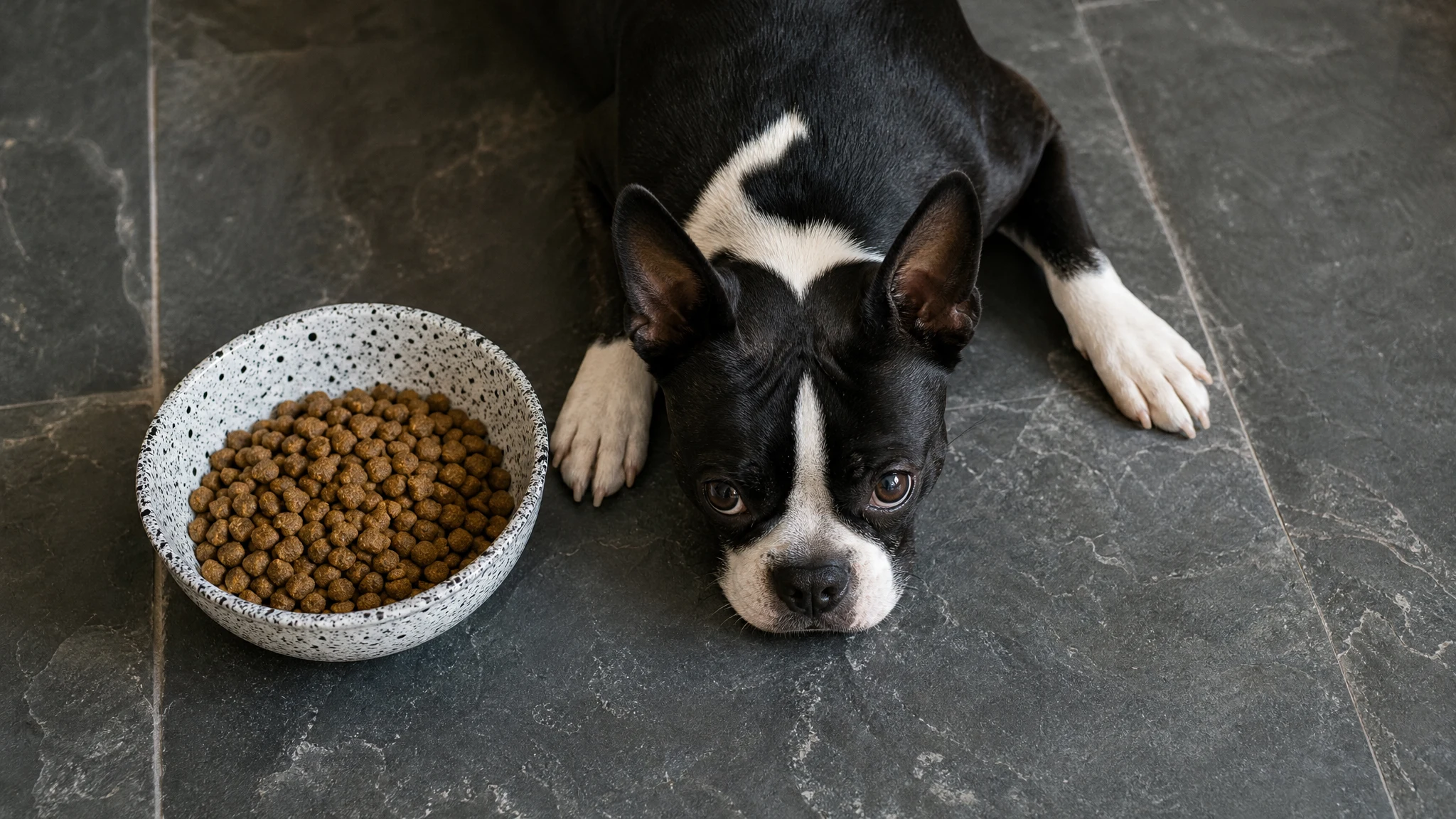
Boston Terriers are small dogs. The American Kennel Club standard, as summarized on Wikipedia, sets weight classes of under 15 lb, 15 to under 20 lb, and 20 to 25 lb. That puts the whole breed within the range that small-breed formulas from Hill's and Royal Canin are written for.
Boston Terriers are also brachycephalic, meaning short-faced. A Vet Times report on a PLOS One study, published in January 2025, found that 62.5 percent of 104 tested Boston Terriers had some grade of brachycephalic airway syndrome. Kibble size is not a treatment for that, and nothing here is veterinary advice. But a short muzzle may make some dogs more likely to scatter or gulp pieces that are awkward to pick up. Your veterinarian is the right person to ask about eating habits and body weight for your individual dog.
Materials you need
- The bag or the brand's product page for each food you are considering
- A ruler or tape measure, for checking pieces from a sample bag
- A kitchen scale or a level measuring cup
- Your dog's current weight and life stage (puppy, adult or senior)
- A notebook to record each food's label data side by side
Step 1: Match the life stage and the AAFCO statement
Find the nutritional adequacy statement. This is the sentence saying the food meets the AAFCO Dog Food Nutrient Profiles or passed feeding tests. It tells you whether the food is for growth, maintenance or all life stages.
For example, Royal Canin's Small Adult page says the food is formulated to meet the AAFCO profiles for maintenance. Its Small Puppy page says the same for growth, including growth of large size dogs (70 lb or more as an adult). Large-size wording does not matter much for a Boston Terrier, because the breed stays well under 70 lb. The Whole Dog Journal explains this AAFCO distinction.
Merrick's Kitchen Comforts Small Breed page did not show an adequacy statement in the information we read. Check the bag or ask Merrick before relying on that food as a complete diet.
Step 2: Read the size claim, then measure the kibble
A "small breed" label is a starting point, not proof that the pieces suit your dog. None of the pages we read give kibble dimensions. Royal Canin and Hill's list kibble size as not stated. Merrick says only "bite sized kibble."
To check for yourself:
- Ask the brand's customer service for the kibble diameter, or buy the smallest bag available.
- Measure several pieces with a ruler and note the range.
- Compare them with your dog's muzzle. Pieces should be easy to pick up and not so tiny that your dog inhales them.
- Break one piece in half. Note whether it snaps cleanly, crumbles or feels very hard.
Texture is not described on these brand pages either, so your own check in step 4 is the only source.
Step 3: Compare label numbers side by side
Copy the figures below into your notebook, then add any other food you are weighing. All numbers come from each brand's own product page. Royal Canin and Merrick list guaranteed minimums, while Hill's publishes average nutrient content on a dry matter basis. Those are not the same measure, so do not compare Hill's percentages directly with the others.
| Food | Life stage | Protein | Fat | Calories per cup | First five ingredients |
|---|---|---|---|---|---|
| Royal Canin Small Adult | Adult, maintenance | 25.0% min | 14.0% min | 359 kcal | Corn, chicken by-product meal, brewers rice, brown rice, corn protein meal |
| Royal Canin Small Puppy | Puppy, growth | 29.0% min | 18.0% min | 349 kcal | Chicken by-product meal, brewers rice, chicken fat, wheat gluten, corn |
| Hill's Science Diet Adult Small & Mini Chicken & Brown Rice | Adult, 1 to 6 years | 25% (dry matter average) | 15.3% (dry matter average) | 357 kcal | Chicken, brown rice, whole grain wheat, whole grain corn, brewers rice |
| Hill's Science Diet Adult 7+ Small & Mini Chicken & Brown Rice | Mature adult, 7+ years | 21.5% (dry matter average) | 15% (dry matter average) | 359 kcal | Chicken, brown rice, whole grain wheat, whole grain corn, brewers rice |
| Hill's Science Diet Puppy Small & Mini Chicken & Brown Rice | Puppy, up to 1 year | 28.9% (dry matter average) | 19.7% (dry matter average) | 418 kcal | Chicken, whole grain oats, brown rice, chicken meal, chicken fat |
| Merrick Kitchen Comforts Small Breed Chicken & Brown Rice | Not stated on page | 27.0% min | 16.0% min | 467 kcal | Chicken, chicken meal, brown rice, barley, oatmeal |
Ingredient lists are as shown on each page and can change from bag to bag. Always read the bag in your hands.
Calories per cup vary a lot, from 349 to 467 in this table. A cup of the Merrick food holds noticeably more energy than a cup of Royal Canin Small Puppy, so the same scoop does not mean the same meal. For a fuller look across more formulas, see our label-by-label comparison of dog foods for Boston Terriers.
Step 4: Run a small texture and tolerance check at home
Once you have a candidate, buy the smallest bag. Mix it into the current food over several days, as the brand or your veterinarian suggests, and watch how your dog handles it. This is your own observation and not a trial.
- Does your dog pick up the pieces easily?
- Does your dog chew them or swallow them whole?
- Are the stools and skin about the same as before?
Skin and digestion deserve a careful note. Wikipedia lists atopic dermatitis and allergic skin disease among the breed's skin conditions. One fresh-food company, Nom Nom, says corn and soy are the main triggers and suggests an 8 week single-ingredient trial. That is a commercial claim, not clinical evidence. If you see itching or stomach upset, talk with your veterinarian before changing foods again.
Step 5: Set a starting portion from the label
Feeding guides are starting points, and your dog's body condition decides the final amount. Hill's Adult Small & Mini page lists these daily amounts:
- 10 lb dog: 1 cup (95 g)
- 15 lb dog: 1 1/3 cups (130 g)
- 20 lb dog: 1 2/3 cups (160 g)
- 25 lb dog: 2 cups (190 g)
Royal Canin's Small Adult page says to split the daily food into 2 to 4 equal portions. Its Small Puppy page offers a calculator instead of printed amounts. Merrick's page says that if you add wet food, you should cut the dry amount by 1/2 cup for every 6 oz of wet food.
Weigh the food, because cups can vary. Ask your veterinarian how much to feed and whether your dog is at a healthy weight, since weight control is relevant for breathing in short-faced breeds.
Tips
- Do not assume a small-breed formula is made for Boston Terriers. The Royal Canin products we read are size-based, and we found no breed-specific formula from any brand.
- Keep treats in the calorie count. A dense food at 467 kcal per cup leaves less room for extras.
- Change foods gradually, and ask your veterinarian about the pace.
- Prescription diets are only something a veterinarian prescribes.
Common mistakes to avoid
- Treating Hill's dry matter percentages as label minimums. They are a different measure.
- Choosing by first ingredient alone. Look at the life stage, the AAFCO statement and the calories as well.
- Buying a large bag first. If the pieces turn out to be wrong for your dog, you are stuck with them.
- Reading too much into grain-free. The FDA's investigation into diets and canine dilated cardiomyopathy had its latest update on December 23, 2022. The FDA says adverse event reports alone do not establish causation, and it does not plan further public updates without meaningful new scientific information. Ask your veterinarian about your dog's diet and heart health.
- Feeding a puppy food to an adult by default. Puppy formulas are higher in calories. Hill's Puppy lists 418 kcal per cup.
What to expect
A food with a suitable AAFCO statement, a sensible portion and pieces your dog handles easily may make mealtimes smoother. It may also help you keep a steady weight, though results vary from dog to dog and no food is a guaranteed fix for any condition. Hip dysplasia, for example, is reported as uncommon in the breed (0.36 percent of Boston Terriers in one North American study cited by Wikipedia), and no food is claimed to prevent or treat it.
If your dog struggles with a food, stops eating or shows changes in skin, stool or breathing, contact your veterinarian. The best dry dog food for Boston Terriers is the one that meets the AAFCO statement for your dog's life stage, fits the pieces to the muzzle, and is approved by the person who knows your dog's health.
Sources
- Royal Canin Small Adult (dry)
- Royal Canin Small Puppy (dry)
- Hill's Science Diet Adult Small & Mini
- Hill's Science Diet Adult 7+ Small & Mini
- Hill's Science Diet Puppy Small & Mini
- Merrick Kitchen Comforts Small Breed Chicken & Brown Rice
- Wikipedia: Boston Terrier
- Vet Times: Boston Terrier brachycephaly analysis
- Nom Nom: Boston Terrier skin allergies (commercial source)
- Whole Dog Journal: large breed puppy food
- FDA: Investigation into diets and canine dilated cardiomyopathy