Best Puppy Food for Boston Terrier Puppies
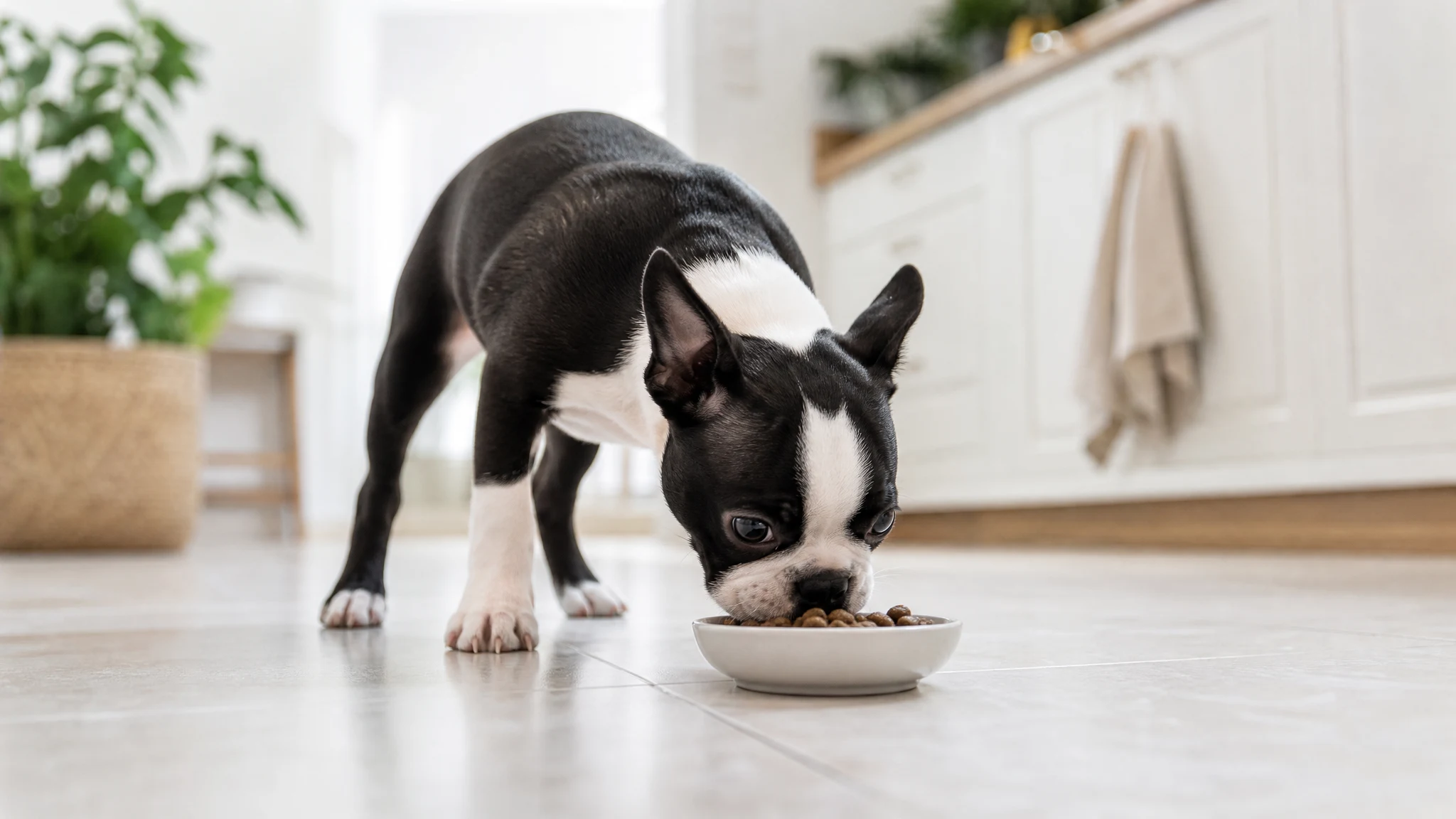
General nutrition information compiled from product labels and published sources, not veterinary advice. Your veterinarian is the right person to choose a diet for your dog, especially one with a health condition.
Choosing Boston Terrier puppy food is mostly a label-reading job. Small dogs grow fast, eat small amounts, and a bag that suits a Labrador puppy may not suit yours. Marketing language does not help much here. The statement on the bag does.
This guide explains what to check, compares three products whose label data covers growth, and points out the claims worth ignoring. If you want the best puppy food for Boston Terriers, the honest answer is the one that is complete and balanced for growth, fits a small mouth, and suits your individual puppy. Your veterinarian makes that final call.
How this comparison was done
We compared label and product-page data: the nutritional adequacy statement, the first ingredients, the guaranteed analysis where one is published, calories and the brand's own feeding guide. We did not run feeding trials or taste tests, and we did not feed any of these foods to dogs. So this is a way to read labels, not a verdict on how any food performs in a real puppy.
Only foods whose label covers growth are in the picks below. Prices are left out on purpose because they change often and vary by seller. Ratings and reviews are left out too.
What a Boston Terrier puppy needs from a food
A small adult size
Wikipedia, summarizing the American Kennel Club standard, lists Boston Terrier weight classes of under 15 lb, 15 lb and under 20 lb, and 20 lb not exceeding 25 lb. That makes the breed small. It fits the size range that Hill's and Royal Canin use for their small-breed formulas.
Why the large-breed wording does not matter much
Puppy food labels often say either "growth including growth of large-size dogs (70 lbs or more as an adult)" or growth "except for" large-size dogs. Whole Dog Journal explains that AAFCO defines large-size as 70 lb or more as an adult. A Boston Terrier is far below that line. For this breed, either version of the growth statement covers the point, so you do not need a "large breed puppy" formula, and you should not pick one.
Weight and breathing
Boston Terriers are a flat-faced breed. A report in Vet Times on a PLOS One study (January 2025) found that 62.5 percent of 104 tested Boston Terriers had some grade of brachycephalic airway obstruction, though the breed showed less severe signs than English or French Bulldogs. Weight control matters for breathing in flat-faced dogs, so calorie awareness is a real feeding concern, not a cosmetic one.
No food treats or prevents airway problems. What a puppy food can do is give you clear calorie data so you can feed measured portions and avoid creeping weight gain. Your veterinarian can tell you what a healthy body condition looks like on your puppy.
What to look for: quality indicators
1. A growth or all life stages statement
This is the first thing to find. In the United States, a complete and balanced dog food carries an AAFCO statement saying it meets the AAFCO Dog Food Nutrient Profiles for a life stage, or that feeding tests support it. For a puppy you want the words "growth" or "all life stages." A statement that says "maintenance" is for adult dogs and is the wrong one for a puppy.
2. The statement is on the label itself
If you cannot find a statement, treat the food as unverified. One of the products we looked at, a Merrick small breed recipe, showed no AAFCO adequacy statement on its product page, and its life stage was not listed. That does not mean the bag lacks one. It means you should read the bag and ask the brand before you consider it for a puppy.
3. Ingredients you can read
Ingredients are listed by weight, so the first five tell you the bulk of the recipe. Look for a named animal protein (chicken, not "meat"), and note whether the first items are grains, by-product meals or whole foods. None of those choices is automatically good or bad. Chicken by-product meal and corn are ordinary ingredients in complete foods. What matters is that the full diet is complete and balanced for growth.
4. Calories per cup
Calories vary a lot between foods. A cup of one puppy food can have far more energy than a cup of another, so switching brands by cup alone can overfeed or underfeed. Check kcal per cup and use the brand's feeding guide as a starting point.
5. Kibble size and texture
Boston Terriers have short muzzles and small mouths. Kibble that is too large or hard to pick up can frustrate some puppies. None of the brand pages we reviewed published kibble dimensions for these products, so ask the brand, or buy a small bag first.
Key features compared
This table uses data from each brand's own product page. Royal Canin and Nom Nom publish guaranteed analysis minimums. Hill's publishes average nutrient content on a dry matter basis, which is not the same thing, so those figures are labeled that way and should not be read as label minimums.
| Feature | Royal Canin Small Puppy (dry) | Hill's Science Diet Puppy Small & Mini Chicken & Brown Rice (dry) | Nom Nom Chicken Cuisine (fresh) |
|---|---|---|---|
| Life stage on label | Growth, including large-size dogs | Puppy up to 1 year; pregnant or nursing | All life stages, including growth of large-size dogs |
| First five ingredients | Chicken by-product meal, brewers rice, chicken fat, wheat gluten, corn | Chicken, whole grain oats, brown rice, chicken meal, chicken fat | Chicken, sweet potatoes, squash, spinach, fish oil |
| Protein | 29.0% minimum | 28.9% average, dry matter basis | 6.5% minimum, as fed |
| Fat | 18.0% minimum | 19.7% average, dry matter basis | 4.5% minimum, as fed |
| Fiber | 3.9% maximum | 2.3% average, dry matter basis | 3.5% maximum, as fed |
| Calories | 349 kcal ME per cup | 418 kcal per cup | 244 kcal per cup |
| Grain free | No | No | Not stated |
| Kibble size | Not published | Not published | Not applicable |
Do not compare the Nom Nom percentages with the dry foods directly. Fresh food contains a lot of water, so its as-fed numbers look much lower. The honest comparison is on a dry matter basis, which Nom Nom's page does not give.
The picks, by type of food
Because we left prices out, these picks are grouped by form of food, not by cost. To compare cost, take the brand's current price and divide by the number of days a bag lasts at the label's starting amount for your puppy's weight. Calories per cup matter here, because a richer food goes further per cup.
Dry, small-breed formula: Royal Canin Small Puppy
Royal Canin's page states that this food is formulated to meet the AAFCO Dog Food Nutrient Profiles for growth including growth of large size dogs (70 lb. or more as an adult). For a Boston Terrier that means the growth requirement is covered.
It is a small-breed formula sized by weight class, not made specifically for Boston Terriers. The first ingredient is chicken by-product meal, followed by brewers rice, chicken fat, wheat gluten and corn. Royal Canin lists 29 percent minimum protein and 18 percent minimum fat, at 349 kcal ME per cup. The daily feeding amounts on the page are an image, and the page offers a calculator for a tailored amount. Start there and adjust with your veterinarian.
You can read the details on Royal Canin's Small Puppy page.
Dry, with a published feeding chart: Hill's Science Diet Puppy Small & Mini
This recipe leads with chicken, then whole grain oats, brown rice, chicken meal and chicken fat. Hill's describes it for puppies up to 1 year, and for pregnant or nursing dogs. The Hill's page opens its adequacy statement with animal feeding tests using AAFCO procedures. Read the full growth wording on the bag before you buy, since we only have the opening of that statement.
Hill's lists 418 kcal per cup, which is noticeably more energy per cup than the Royal Canin food above. That matters for portion sizes. For a 10 lb puppy, Hill's feeding guide gives 1 1/2 cups a day under 4 months, 1 1/3 cups at 4 to 9 months, and 1 cup at 10 to 12 months. Treat those as starting points, not targets.
See Hill's Science Diet Puppy Small & Mini page for the current label.
Fresh food: Nom Nom Chicken Cuisine
Nom Nom's page says this recipe is formulated to meet the AAFCO Dog Food Nutrient Profiles for all life stages, including growth of large size dogs. It is not sold by size or breed. The first five ingredients are chicken, sweet potatoes, squash, spinach and fish oil. Calories are 244 kcal per cup, which is lower per cup than the dry foods, so cups cannot be swapped one for one.
Nom Nom's feeding guide gives 1 cup (218 g) a day for a 10 lb dog, when it is the whole diet. That guide is written for dogs in general, not specifically for growing puppies, so ask your veterinarian how to adjust for age. Details are on Nom Nom's Chicken Cuisine page.
A note on what was left out
We found no Boston Terrier-specific formula from any brand we could check. Royal Canin's products are size-based, and Hill's are labeled for small and mini breeds. Several other well-known brands could not be checked, so their absence here is not a judgment. The same label checks work for any brand.
Feeding amounts and meal timing
Puppies have small stomachs and high energy needs, so most are fed several small meals a day instead of one large one. Royal Canin's adult page recommends 2 to 4 equal portions per day, and a young puppy is generally closer to the higher end of that. Ask your veterinarian for a schedule that fits your puppy's age.
Some practical points:
- Weigh the food at first, or use a proper measuring cup, because scooping varies by several tablespoons.
- Use the label guide for your puppy's current weight, and move down the chart as the puppy grows.
- Count treats and training rewards in the daily total.
- Weigh your puppy regularly and share the numbers with your veterinarian.
The label amounts are starting points. A very active puppy and a calm one of the same weight may need different amounts.
When to switch to adult food
We did not find a source that gives one age at which Boston Terriers should move to adult food. Hill's frames its puppy recipe as running up to 1 year. Because this is a small breed that finishes growing earlier than large breeds, many owners move to an adult food around the end of the first year, but your veterinarian should confirm the timing based on your puppy's growth and body condition.
When you do switch, mix the new food into the old over about a week. Sudden changes often cause an upset stomach.
Red flags to avoid
- No adequacy statement. If you cannot find the AAFCO wording on the bag or the product page, ask the brand before you buy.
- "Maintenance" only. That statement is for adult dogs and is not meant for a growing puppy.
- Disease claims. A food that says it prevents, treats or cures allergies, heart disease or joint problems is making a medical claim. Only a veterinarian can prescribe a therapeutic diet.
- "Large breed puppy" marketed to a Boston Terrier. The breed tops out around 25 lb, so a large-breed formula is solving a problem your puppy does not have.
- Vague ingredients. Terms like "meat meal" with no animal named make it hard to know what is in the bag.
- Cup-only feeding advice. Good labels give calories per cup so you can portion by energy, not guesswork.
- Fear-based grain-free marketing. The FDA's investigation page on diet and canine dilated cardiomyopathy was last updated on December 23, 2022, and says adverse event reports alone do not establish causation. The agency does not plan more public updates until there is meaningful new scientific information. Grain-free is not a quality marker on its own. If you are unsure, ask your veterinarian.
Itchy skin, gas and food allergy claims
Wikipedia lists atopic dermatitis and allergic skin disease among the breed's skin conditions. One fresh-food company, Nom Nom, says in an article that corn and soy are common triggers and suggests an 8 week single-ingredient trial. That is a commercial claim, not clinical evidence. If your puppy is itchy or gassy, see your veterinarian before changing foods yourself, since there are many possible causes and a proper elimination trial is vet-guided.
Where to buy
Buy from a source that keeps food fresh and gives you the full label. A few options are worth considering:
- The brand's own website. You get the current label, ingredient list and feeding guide, and the brand can answer questions about kibble size.
- Your veterinarian's office. Many clinics stock puppy foods and can recommend one for your puppy's weight.
- A local pet supply shop. You can read the bag in person and buy a small size to see whether your puppy likes it.
Whichever you pick, start with a small bag. Check the date on the bag, store the food in a cool, dry place in its original packaging, and keep the lot information in case you have a question later. Ingredient lists can change between production runs, so always read the bag in your hands, not just the page you saw online.
The bottom line
The best food for a Boston Terrier puppy is one with a clear growth or all life stages statement, a calorie count you can measure against, and a recipe your puppy tolerates well. The three products above each meet the first test on their own product pages, and Hill's wording should be confirmed on the bag. After that, it comes down to your puppy's weight, stools, coat and energy, and your veterinarian's advice.
Sources
- Royal Canin: Small Puppy dry dog food
- Hill's Pet: Science Diet Puppy Small & Mini Chicken & Brown Rice Recipe
- Nom Nom: Chicken Cuisine
- Nom Nom: Boston Terrier skin allergies article (commercial source)
- FDA Center for Veterinary Medicine: investigation into diets and canine dilated cardiomyopathy
- Vet Times: new Boston Terrier brachycephaly analysis published
- Whole Dog Journal: large breed puppy food and AAFCO large-size definition
- Wikipedia: Boston Terrier