Wet vs Dry vs Fresh Food for Boston Terriers
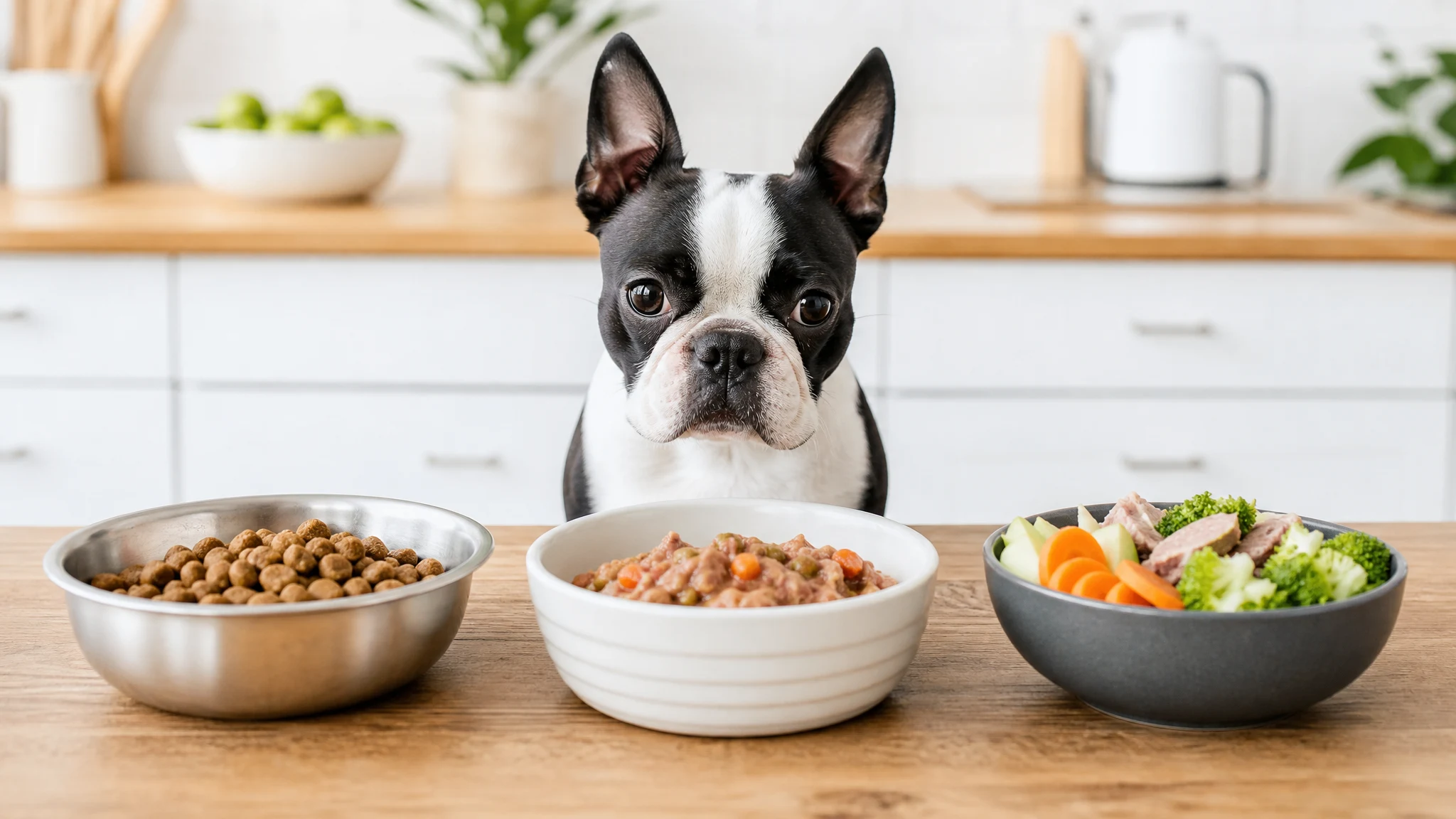
General nutrition information compiled from product labels and published sources, not veterinary advice. Your veterinarian is the right person to choose a diet for your dog, especially one with a health condition.
Most Boston Terrier owners end up weighing the same three options: a bag of kibble, a stack of cans, or a subscription box of fresh food. Each can be a sound choice. They differ in water content, calories per serving, how much you handle at mealtime, and how well they fit a small, flat-faced dog.
This page compares the three forms using real label data for one or more products in each. It also covers what wet vs dry dog food changes for a dog this size, and where the marketing runs ahead of the evidence.
How we compared them
We compared label data: AAFCO statements, ingredient order, guaranteed analysis, calories and the feeding guides the brands publish. We did not run feeding trials or taste tests, and we are not ranking flavor or stool quality. Prices are left out on purpose because they change by store, bag size and subscription.
The products used as examples are Royal Canin Small Adult (dry) and Canine Health Nutrition Beauty Adult Loaf in Sauce (wet), Hill's Science Diet Adult Small & Mini Chicken & Brown Rice (dry), Merrick Kitchen Comforts Small Breed (dry), and Nom Nom Chicken Cuisine (fresh). None of them is a Boston Terrier-specific formula. Royal Canin and Hill's sell size-based small-breed foods, and we did not confirm a breed-specific formula from any brand.
For a full product-by-product breakdown, see our label comparison of dog foods for Boston Terriers.
Why size and breathing matter for this breed
Boston Terriers are small. Wikipedia, summarizing the AKC standard, lists weight classes of under 15 lb, 15 to under 20 lb, and 20 to 25 lb. That fits comfortably inside the small-breed ranges that Hill's (up to 25 lb full grown) and Royal Canin use for their small-dog foods.
Weight also touches breathing. A Vet Times report on a PLOS One study found that 62.5 percent of 104 tested Boston Terriers had some grade of brachycephalic airway syndrome (grades 1 to 3), although the breed was less severely affected than English or French Bulldogs. Because excess weight can make breathing harder for flat-faced dogs, calories per serving is the number to watch more than almost anything else on the label. Your veterinarian can tell you what a healthy weight looks like for your individual dog.
Side-by-side comparison
| Attribute | Dry | Wet | Fresh |
|---|---|---|---|
| Example products | Royal Canin Small Adult; Hill's Adult Small & Mini; Merrick Small Breed | Royal Canin Beauty Adult Loaf in Sauce | Nom Nom Chicken Cuisine |
| Moisture | Lowest of the three | High. Water is the first ingredient on the Royal Canin loaf | High. Chicken, sweet potatoes and squash lead the ingredient list |
| Calories per serving | Royal Canin 359 kcal per cup; Hill's 357 kcal per cup; Merrick 467 kcal per cup | 155 kcal per can (1,034 kcal/kg) | 244 kcal per cup (219 g cup) |
| Protein, as fed (label minimum) | Royal Canin 25%; Merrick 27%. Hill's publishes dry matter averages instead (25%) | 7.4% | 6.5% |
| Fat, as fed (label minimum) | Royal Canin 14%; Merrick 16% | 4.2% | 4.5% |
| Cost per day, in general terms | Usually the lowest of the three | Usually higher, since a small dog may need several cans a day | Usually the highest, and often sold as a recurring order |
| Storage and handling | Pantry, scoop and go | Pantry until opened, then refrigerate leftovers | Refrigerator or freezer space, thawing |
| Life-stage statement on the page | Royal Canin and Hill's: adult maintenance; Merrick: not found on the page | Adult maintenance | All life stages |
One caution on the protein and fat rows. Wet and fresh foods contain a lot of water, so their as-fed percentages look low next to kibble. That does not mean they are lower in protein once water is removed. The numbers are not directly comparable unless they are converted to a dry matter basis. Hill's lists dry matter averages, which is a different measure than the as-fed minimums the other brands print.
Dry food
What the labels show
Royal Canin Small Adult lists corn, chicken by-product meal, brewers rice, brown rice and corn protein meal first, with 25 percent minimum protein, 14 percent minimum fat and 359 kcal per cup. Hill's Adult Small & Mini lists chicken, brown rice, whole grain wheat, whole grain corn and brewers rice, at 357 kcal per cup. Merrick Kitchen Comforts Small Breed lists chicken, chicken meal, brown rice, barley and oatmeal, and is much denser at 467 kcal per cup.
That gap matters. A cup of the Merrick has about 30 percent more calories than a cup of the other two, so a cup-for-cup swap between brands can add weight fast. Always start from the feeding guide for the exact bag.
Pros
- Lowest cost per day in general terms.
- Easy to measure, store and use in puzzle toys or as training rewards.
- Hill's publishes a weight-based guide that covers the Boston Terrier range: 1 cup (95 g) for a 10 lb dog, 1 1/3 cups for 15 lb, 1 2/3 cups for 20 lb and 2 cups for 25 lb. Treat these as starting points.
Cons
- Calorie density varies a lot by brand, so over-scooping is easy.
- Low moisture, so your dog gets less water from the food itself.
- Kibble size matters for small, short-muzzled mouths, and none of the pages we used gave dimensions. Merrick says only "bite sized kibble." Check with the brand or look at the kibble in the bag.
Wet food
What the label shows
Royal Canin's Beauty Adult Loaf in Sauce lists water, chicken, pork by-products, pork liver and corn meal first. It carries 7.4 percent minimum protein, 4.2 percent minimum fat and 155 kcal per can. Royal Canin's feeding guide runs from 1 can (152 g) for a 4.4 lb dog at low activity to 3 to 4 cans for a 22 lb dog, depending on activity.
Simple multiplication of those label figures puts a 22 lb dog at roughly 465 to 620 kcal a day on cans alone. That is a lot of cans, and it is the main reason wet food as the only diet tends to cost more for a dog this size than kibble. Royal Canin describes this loaf for dogs up to 22 lb, so an adult at the top of the Boston Terrier range should check the brand's guidance first.
Pros
- High water content, with a soft texture that some dogs find easier to eat.
- No kibble-size question.
- Works as a topper to make a dry diet more appealing.
Cons
- Higher cost per day when it is the whole diet.
- Open cans need refrigeration and have to be used up.
- A single loaf formula is one recipe, so check the AAFCO statement on the specific can.
Fresh food
What the label shows
Nom Nom's Chicken Cuisine lists chicken, sweet potatoes, squash, spinach and fish oil first. It carries 6.5 percent minimum protein, 4.5 percent minimum fat, 3.5 percent maximum fiber and 244 kcal per cup. Its AAFCO statement is for all life stages, including growth of large size dogs. Large-size means 70 lb or more as an adult, which does not describe a Boston Terrier, so that wording does not rule it out for this breed.
Nom Nom's own feeding guide gives 1 cup (218 g) a day for a 10 lb dog and 2 cups (366 g) a day for a 20 lb dog on an all-Nom Nom diet. Nom Nom sells to all sizes and has no breed-specific recipe.
One caution about sources. A Nom Nom article says corn and soy are the main triggers for food allergies in Boston Terriers and suggests an 8-week single-ingredient food trial. That is one fresh-food company's view, not clinical evidence. Wikipedia lists atopic dermatitis and allergic skin disease among the breed's skin conditions, but no food form prevents or treats them. If your dog is itchy, a veterinarian should sort out the cause and decide on any elimination diet.
Pros
- Whole-food ingredient list that is easy to read.
- All-life-stages statement can simplify things for a household with a puppy and an adult.
- Soft, moist texture, with no kibble-size concern.
Cons
- Usually the highest cost per day in general terms.
- Needs refrigerator or freezer space and planning around deliveries.
- Brand pages did not tell us whether the recipe is grain free, so check the brand if that matters to you.
Dental myths
A common claim is that dry food cleans teeth and wet food ruins them. We did not find that supported in the label and source material we used. None of the brand pages above makes a dental claim for the form itself. Boston Terriers have short, crowded mouths, and dental care is a conversation to have with your veterinarian, who can look at your dog's teeth. Do not pick a form on dental grounds alone.
Mixing forms
Mixing is common and works fine when you count calories. Merrick's page gives a concrete rule for it: if you add wet food, cut the dry amount by 1/2 cup for every 6 oz of wet food. The idea is to trade calories, not stack them.
A simple way to do it with label numbers:
- Start from the dry food's feeding guide for your dog's weight.
- Decide how many calories the topper will supply, using its kcal per can or per cup.
- Reduce the dry portion by the same number of calories.
- Check your dog's body condition after a few weeks and adjust with your veterinarian's advice.
Switching foods should also be gradual, as the brands themselves advise on their pages, so your dog's stomach has time to adjust.
Best for, by use case
- Everyday budget feeding: dry. It has the lowest cost per day in general terms and the easiest portioning.
- A picky eater: dry with a measured wet topper, with calories traded as shown above.
- A dog that needs more water in the diet or struggles with hard kibble: wet or fresh, after a veterinarian checks the reason.
- An owner who wants a short, whole-food ingredient list and has the budget and freezer space: fresh.
- A growing puppy: a food whose statement covers growth. Royal Canin Small Puppy and Nom Nom carry growth statements. Hill's Puppy Small & Mini is a puppy food, but the page excerpt we captured was only partial, so read the full statement on the bag.
- A dog with itching, digestive trouble or a weight problem: a veterinarian's decision. Prescription diets are only something a veterinarian prescribes.
The verdict
No form is the best wet vs dry dog food winner for every Boston Terrier. The label data points to a few clear conclusions.
First, dry food is the most practical default for most households. It is the easiest to portion and usually costs the least per day. Choose a small-breed formula with a complete and balanced statement that matches your dog's life stage, and measure it by weight or by the brand's guide, not by habit.
Second, wet food for Boston Terriers is best used as a topper or a rotation partner. Fed alone it can take several cans a day, even for a dog of this size, and the as-fed protein numbers look low only because of the water.
Third, fresh dog food for Boston Terriers is a reasonable choice if the cost and storage suit you. The Nom Nom label we reviewed shows a complete all-life-stages statement and clear calories. But the allergy claims around it come from a company that sells the product, so weigh them accordingly.
Whatever you pick, keep calories steady and watch your dog's weight, because that matters for breathing in this breed. If your dog has a medical condition, ask your veterinarian before changing forms.
Sources
- Royal Canin Small Adult (dry)
- Royal Canin Small Puppy (dry)
- Royal Canin Canine Health Nutrition Beauty Adult Loaf in Sauce (wet)
- Hill's Science Diet Adult Small & Mini Chicken & Brown Rice
- Hill's Science Diet Puppy Small & Mini Chicken & Brown Rice
- Nom Nom Chicken Cuisine
- Merrick Kitchen Comforts Small Breed Chicken & Brown Rice
- Nom Nom article on Boston Terrier skin allergies
- Vet Times: Boston Terrier brachycephaly analysis (PLOS One study)
- Wikipedia: Boston Terrier