Balanced Diet for Boston Terriers: Portioning It Correctly by Weight
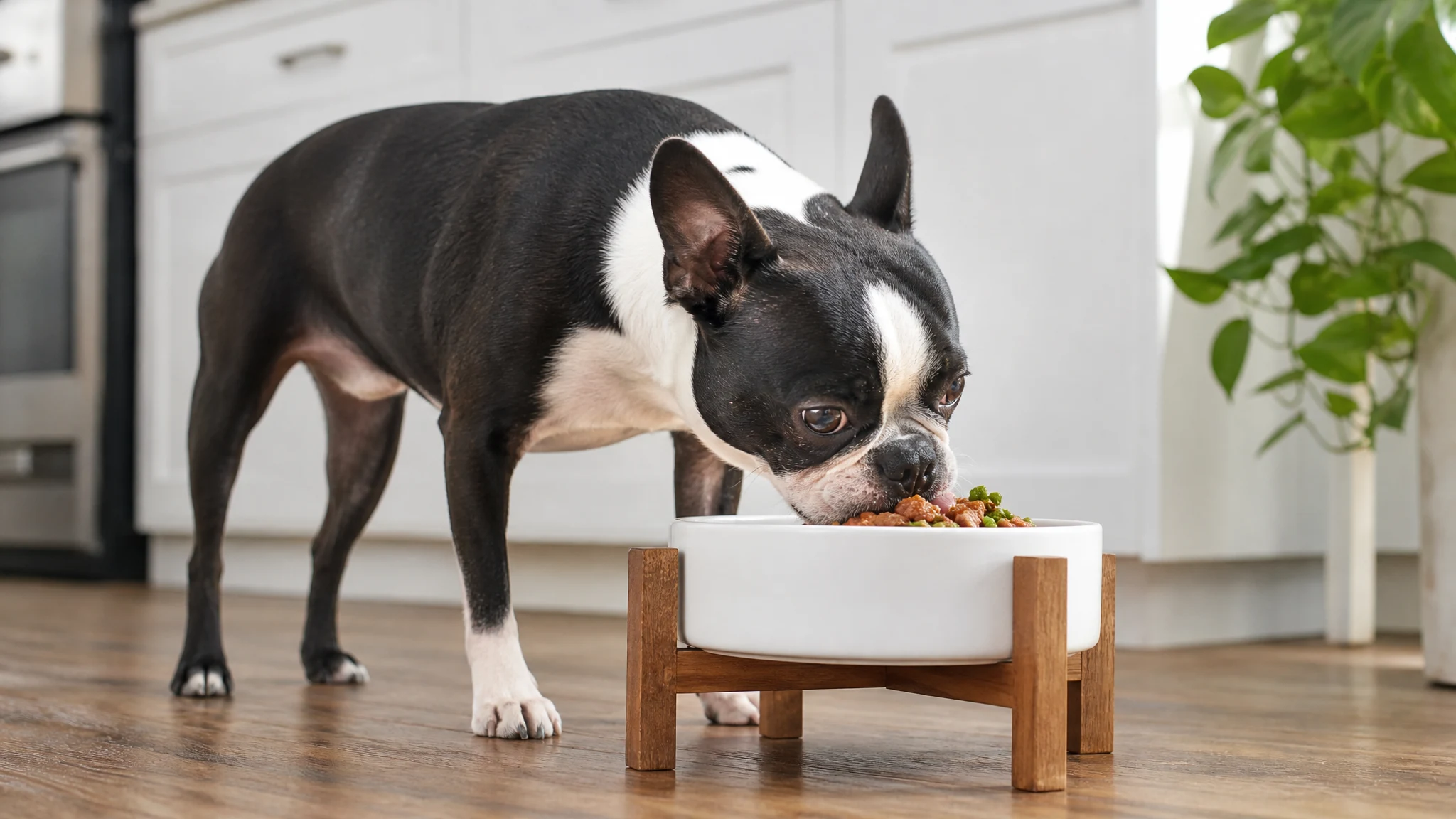
General nutrition information compiled from product labels and published sources, not veterinary advice. Your veterinarian is the right person to choose a diet for your dog, especially one with a health condition.
A good bowl of food does two jobs. It has to be nutritionally complete, and it has to be the right size for your dog. Boston Terriers are compact, and a few extra scoops a day make up a large share of their needs.
This guide walks you through how to build a balanced diet for Boston Terriers by weight, using real label data. It shows you how to find the starting amount, how to track it, and when to ask your veterinarian for help.
Why weight is the starting point
According to Wikipedia's summary of the AKC breed standard, Boston Terriers are shown in three weight classes: under 15 lb, 15 lb and under 20 lb, and 20 lb not exceeding 25 lb. That is a small dog. It fits the small-breed formulas that brands such as Hill's and Royal Canin publish, which cover dogs up to about 25 lb.
Weight matters for another reason. A Vet Times report on a PLOS One study (January 2025) found that 62.5 percent of 104 tested Boston Terriers had some grade of brachycephalic airway syndrome, though the breed's cases were less severe than those in English or French Bulldogs. Keeping a flat-faced dog lean is a common point of discussion for breathing comfort. Your veterinarian can tell you what a healthy weight looks like for your individual dog.
What you need
- A complete and balanced food with an AAFCO statement for your dog's life stage
- A dry measuring cup, or better, a kitchen scale that reads in grams
- The feeding guide from the bag or the brand's own page
- A bathroom or pet scale to weigh your dog
- A notebook or phone note to log weight, portions and treats
Step 1: Weigh your dog
Weigh yourself holding your dog, then weigh yourself alone, and subtract. Do this once a month. Feeding guides are built around weight, so a guess of "about 18 pounds" can move you into a different row of the chart.
Step 2: Pick a food that states it is complete and balanced
Look for the AAFCO statement on the bag. For example, Royal Canin's Small Adult dry food says it is formulated to meet the AAFCO Dog Food Nutrient Profiles for maintenance. Hill's Science Diet Adult Small & Mini says animal feeding tests using AAFCO procedures substantiate that it provides complete and balanced nutrition for maintenance of adult dogs.
The statement names a life stage. Adult maintenance foods are for adults. Growth foods are for puppies. Some brands label a food for "all life stages."
One note on puppy labels: some growth foods say they cover "growth of large size dogs (70 lbs. or more as an adult)." AAFCO defines large size as 70 lb or more as an adult, according to Whole Dog Journal. A Boston Terrier is far below that, so that wording does not limit your choice.
None of the brands we looked at make a Boston Terrier-specific formula. What exists are small-breed formulas. For a side-by-side look at ingredients and label numbers, see our label comparison of foods for Boston Terriers. We compared label data only. We did not run feeding trials or taste tests.
Step 3: Find the starting amount on the feeding guide
Each brand publishes its own chart. Here are the daily amounts Hill's lists for its Adult Small & Mini Chicken & Brown Rice dry food, which the brand says is for adult dogs up to 25 lb full grown:
| Dog's weight | Daily amount (Hill's Adult Small & Mini) |
|---|---|
| 10 lb | 1 cup (95 g) |
| 15 lb | 1 1/3 cups (130 g) |
| 20 lb | 1 2/3 cups (160 g) |
| 25 lb | 2 cups (190 g) |
Hill's also publishes a Mature Adult 7+ Small & Mini recipe. Its guide is lower: 7/8 cup (85 g) at 10 lb, 1 1/8 cups (110 g) at 15 lb, 1 1/2 cups (150 g) at 20 lb, and 1 2/3 cups (165 g) at 25 lb.
These are starting points, not fixed rules. Another food has another chart, because calorie content differs. Hill's Adult lists 357 kcal per cup. Royal Canin Small Adult lists 359 kcal per cup. Merrick Kitchen Comforts Small Breed lists 467 kcal per cup, so a cup of it carries noticeably more energy than a cup of the others. Always use the chart that belongs to the food in your bowl.
Step 4: Adjust for age and activity
Age changes the chart you use. Puppies eat more per pound than adults. Hill's Puppy Small & Mini guide, for a 10 lb puppy, lists 1 1/2 cups under 4 months, 1 1/3 cups at 4 to 9 months, and 1 cup at 10 to 12 months. The amount goes down as the puppy grows. We could not confirm at what age Boston Terriers are fully adult, so ask your veterinarian when to switch to an adult food.
Activity matters too. Royal Canin's wet Canine Health Nutrition Beauty Adult loaf gives a range for a 22 lb dog: 3 to 4 cans depending on activity. A couch-loving dog sits near the low end. A dog that runs the yard daily sits nearer the high end.
Step 5: Divide it into meals
Royal Canin recommends feeding 2 to 4 equal portions per day for its Small Adult food. Two meals is the usual routine for an adult, and puppies often do better with more frequent, smaller meals. Measure the whole day's amount first, then split it.
Step 6: Measure accurately
Scoops vary a lot. A heaping cup can hold far more kibble than a level one. If the guide gives grams, weigh it. Hill's lists both cups and grams, which makes a scale easy to use.
Step 7: Count everything else in the day
Treats, chews, toppers and table scraps all add calories. Subtract them from the bowl. If you mix in wet food, check the brand's guidance. Merrick says to reduce the dry amount by 1/2 cup for every 6 oz of wet food added.
Fresh food follows its own numbers. Nom Nom's Chicken Cuisine lists 244 kcal per cup and says a 10 lb dog gets 1 cup (218 g) per day on a fully Nom Nom diet. Do not swap cups between a fresh food and a kibble.
Step 8: Check, log and adjust
Every two to four weeks, look at your dog from above and from the side. You should be able to feel the ribs under a thin layer of padding, and you should see a waist. If the ribs are hard to find, trim the portion a little. If they are very easy to see, increase it a little. Small changes work best, and your veterinarian can confirm the target weight.
Reading the numbers on a label
Compare foods on the same basis. Royal Canin and Merrick list guaranteed minimums as fed, such as 25 percent protein and 14 percent fat for Royal Canin Small Adult. Hill's pages show average nutrient content on a dry matter basis, so those figures are not the same kind of number. Do not line them up directly against as-fed minimums.
The ingredient list also helps. It is ordered by weight, so the first five ingredients show what the recipe leans on. Ingredients can change from bag to bag, so check the bag you are holding.
Tips
- Switch foods slowly, mixing the new food in over about a week, unless your veterinarian says otherwise.
- Keep the chart and your dog's weight log in the same place.
- Weigh the dog before you change the amount, not after.
- Read the bag for the AAFCO statement, not the front-of-bag marketing.
Common mistakes
- Using a heaping scoop. It can quietly add a lot of calories.
- Forgetting treats. They count toward the day's total.
- Using the wrong chart. A puppy chart for an adult, or one brand's chart for another brand's food, gives the wrong amount.
- Trusting "grain free" as a shortcut. The FDA's investigation into diets and canine dilated cardiomyopathy had its last update on December 23, 2022. The FDA says adverse event reports alone do not establish causation. If you have questions about your dog's heart or your food choice, ask your veterinarian.
- Treating a food as a medical fix. No food shown here is claimed to prevent or treat a disease.
Skin, itching and food sensitivities
Wikipedia lists atopic dermatitis and allergic skin disease among the breed's skin conditions. One fresh-food company, Nom Nom, says corn and soy are the main triggers and suggests an 8 week single-ingredient trial. That is a company's view and not clinical evidence. If your dog itches or has gas, talk to your veterinarian before changing the diet. A prescription diet is something only a veterinarian can prescribe.
Expected results
When portions match your dog's weight, age and activity, many owners see steady weight and regular meal-time routines over several weeks. Stools, energy and coat may also look consistent, but results vary from dog to dog and depend on many factors besides food. Weight and body condition are the best things to track.
When to ask your veterinarian
Confirm amounts with your veterinarian if your dog has a health condition, is pregnant or nursing, is losing or gaining weight without a clear reason, or is a puppy or senior. The same goes for any supplement. Do not add one on your own, and let your veterinarian set any amount. Your veterinarian decides what is right for an individual dog.
Sources
- Hill's Science Diet Adult Small & Mini Chicken & Brown Rice
- Hill's Science Diet Adult 7+ Small & Mini Chicken & Brown Rice
- Hill's Science Diet Puppy Small & Mini Chicken & Brown Rice
- Royal Canin Small Adult (dry)
- Royal Canin Canine Health Nutrition Beauty Adult Loaf in Sauce
- Merrick Kitchen Comforts Small Breed Recipe
- Nom Nom Chicken Cuisine
- FDA: Investigation into Potential Link between Certain Diets and Canine Dilated Cardiomyopathy
- Vet Times: Boston Terrier brachycephaly analysis
- Wikipedia: Boston Terrier
- Whole Dog Journal: large breed puppy food and AAFCO wording