Best Canned Dog Food for Boston Terriers: How to Mix It Into a Feeding Routine
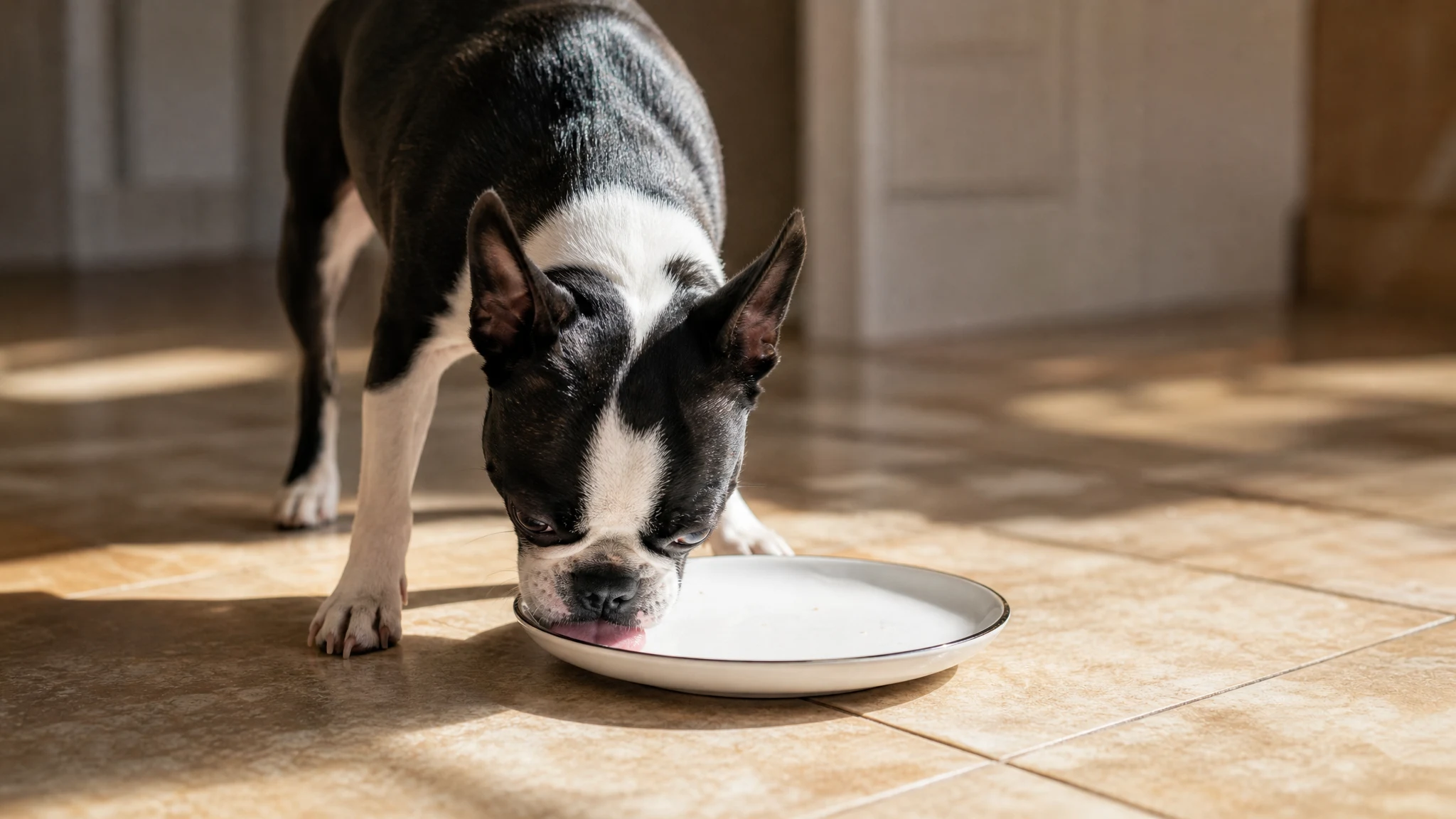
General nutrition information compiled from product labels and published sources, not veterinary advice. Your veterinarian is the right person to choose a diet for your dog, especially one with a health condition.
Wet food can make meals more appealing, and it can work alongside dry kibble. But a can added on top of a full bowl of kibble is just extra calories. This guide shows how to choose a can by its label and fold it into your Boston Terrier's day without overfeeding.
We compared label data only. We did not run feeding trials or taste tests, and nothing here is a ranking of how dogs respond to a food.
Why portions matter for this breed
Boston Terriers are small. Wikipedia, summarizing the AKC standard, lists weight classes of under 15 lb, 15 to under 20 lb, and 20 to 25 lb. That puts the whole breed in the small-dog range.
Weight control also matters for breathing. A Vet Times report on a PLOS One study (January 2025) found that 62.5 percent of 104 tested Boston Terriers had some grade of brachycephalic airway obstruction. Boston Terriers were less affected than English or French Bulldogs. A food does not treat or prevent this condition. Your veterinarian is the one to ask how lean your dog should be.
Materials you need
- A canned (wet) food with a complete and balanced statement for your dog's life stage
- Your dog's usual dry food, with its feeding guide
- A kitchen scale or a level measuring cup
- A can lid or airtight container for leftovers
- A notebook or phone note to track weight and amounts
Step 1: Read the can before you buy
Look for the AAFCO statement. It should say the food meets the AAFCO Dog Food Nutrient Profiles for maintenance (adults), growth (puppies), or all life stages. Without that statement, the food may be a topper rather than a full meal.
The one canned food we have label data for is Royal Canin's Canine Health Nutrition Beauty Adult Loaf in Sauce. Its label says it is formulated to meet the AAFCO nutrient profiles for maintenance. Royal Canin lists it for small dogs, and its page covers dogs up to 22 lb. A Boston Terrier at the top of the breed range, near 25 lb, is above that. Check with Royal Canin or your vet about fit.
Royal Canin does not make a Boston Terrier-specific formula that we found. This is a small-dog formula, not a breed formula. The same is true of the other brands we looked at.
Step 2: Compare the numbers that matter
For a can, use the guaranteed analysis and the calories per can. Moisture is high in wet food, so percentages look small next to kibble. Do not compare them directly.
| Label item | Royal Canin Beauty Adult Loaf in Sauce |
|---|---|
| Form | Wet, loaf in sauce |
| First five ingredients | Water sufficient for processing, chicken, pork by-products, pork liver, corn meal |
| Crude protein (min) | 7.4% |
| Crude fat (min) | 4.2% |
| Crude fiber (max) | 1.7% |
| Calories | 155 kcal ME per can (as fed, calculated) |
Ingredient lists can change by batch, so read the can in your hand. Royal Canin publishes the product on its own page: Royal Canin Canine Health Nutrition Beauty Adult. For the full side-by-side of wet, dry and fresh options, see our label comparison of dog foods for Boston Terriers.
Step 3: Start from the label's feeding guide
Royal Canin's page gives examples for the wet food. A 4.4 lb dog gets one can (152 g) at low activity. A 22 lb dog gets 3 to 4 cans depending on activity. Those are starting points, not targets. Weight, age and activity all change what your dog needs.
For the dry side, use that food's own guide. Hill's Science Diet Adult Small & Mini Chicken & Brown Rice lists 1 1/3 cups a day for a 15 lb dog and 1 2/3 cups for a 20 lb dog. It also lists 357 kcal per cup. You can read it on the Hill's Science Diet product page.
Puppies and seniors have their own guides. Hill's has separate small-breed puppy and 7+ pages, and Royal Canin has a Small Puppy formula. The amounts differ, so use the guide that matches your dog's life stage.
Step 4: Cut the dry food to make room
This is the step most owners skip. Wet food adds calories, so dry food has to come down by about the same amount.
Some brands give a rule. Merrick, for its Kitchen Comforts Small Breed dry food, says to reduce the dry amount by 1/2 cup for every 6 oz of wet food added. Merrick's page lists that food at 467 kcal per cup, and the page did not give an AAFCO statement we could confirm, so check the bag. That rule suits Merrick's own dry food, not every kibble.
With other foods, you can work from label calories. Here is a worked example using the figures above, and it is arithmetic only. A 15 lb dog on the Hill's guide gets about 476 kcal a day (1 1/3 cups at 357 kcal). One can of the Royal Canin loaf is 155 kcal, roughly 0.43 of a Hill's cup. Swapping one can in means trimming about that much kibble. Your dog's needs may differ, so ask your vet to confirm.
Step 5: Set a simple schedule
Royal Canin's dry Small Adult page recommends 2 to 4 equal portions a day. For many owners, that means two or three meals.
- Split the day's total (dry plus wet) into equal meals.
- Put the wet portion in one or two of those meals, or divide it across all of them.
- Mix it into the kibble or serve it beside it.
- Pick up leftovers after the meal.
Open cans should be covered and refrigerated. Check the label for how long a can keeps.
Step 6: Switch gradually
Start with a small spoonful of wet food in the usual meal and raise it over several days, trimming kibble as you go. Watch stool and appetite. If your dog has loose stools, vomiting or itching, stop and call your vet.
Be careful about reading a food as the cause of itching. One fresh-food company, Nom Nom, says corn and soy are common triggers in Boston Terriers and suggests an 8-week single-ingredient trial. That is a commercial claim, not clinical evidence. If you suspect a food allergy, ask your veterinarian to guide any elimination trial.
Step 7: Weigh and adjust
Weigh your dog every two to four weeks and note the amounts. Check body shape too: you should be able to feel the ribs under a thin layer of padding. If weight creeps up, lower the portions slightly and check again. If it drops, tell your vet before adding more.
Tips
- Choose one food change at a time, so you know what caused any reaction.
- Warm the wet food slightly if your dog is hesitant. Test it so it is not hot.
- Count treats and chews in the daily total.
- Keep the same can, or the same brand, for a few weeks before judging it.
- Check if the product is called a complete meal or a topper before relying on it.
Common mistakes to avoid
- Adding without subtracting. A can on top of a full bowl raises calories.
- Using the wrong life stage. A puppy needs a growth statement. An adult can use maintenance or all life stages.
- Assuming a breed name means a breed formula. The labels we compared are size-based.
- Judging by percentages across forms. Wet, dry and fresh foods hold different amounts of water.
- Chasing grain-free for its own sake. The FDA's page on its investigation into diets and canine dilated cardiomyopathy was last updated on December 23, 2022. It says adverse event reports alone do not establish causation. Talk to your vet rather than guessing.
What to expect
Many owners find that a mixed routine makes meals more appealing, and some dogs eat more willingly. Results vary. Your dog's weight, stool quality and energy are the things to watch over the first several weeks.
No food is a guarantee of a particular outcome, and none prevents or treats a disease. If your dog has a health condition such as skin disease, airway trouble or a weight problem, confirm amounts and food choice with your veterinarian before changing the routine. Prescription diets come only from a vet.
Sources
- Royal Canin: Canine Health Nutrition Beauty Adult Loaf in Sauce
- Royal Canin: Small Adult dry dog food
- Hill's Science Diet: Adult Small & Mini Chicken & Brown Rice
- Merrick: Kitchen Comforts Small Breed Chicken & Brown Rice
- Vet Times: Boston Terrier brachycephaly analysis
- FDA: Investigation into diets and canine dilated cardiomyopathy
- Wikipedia: Boston Terrier