Best Training Treats for Boston Terriers (and How Many to Give)
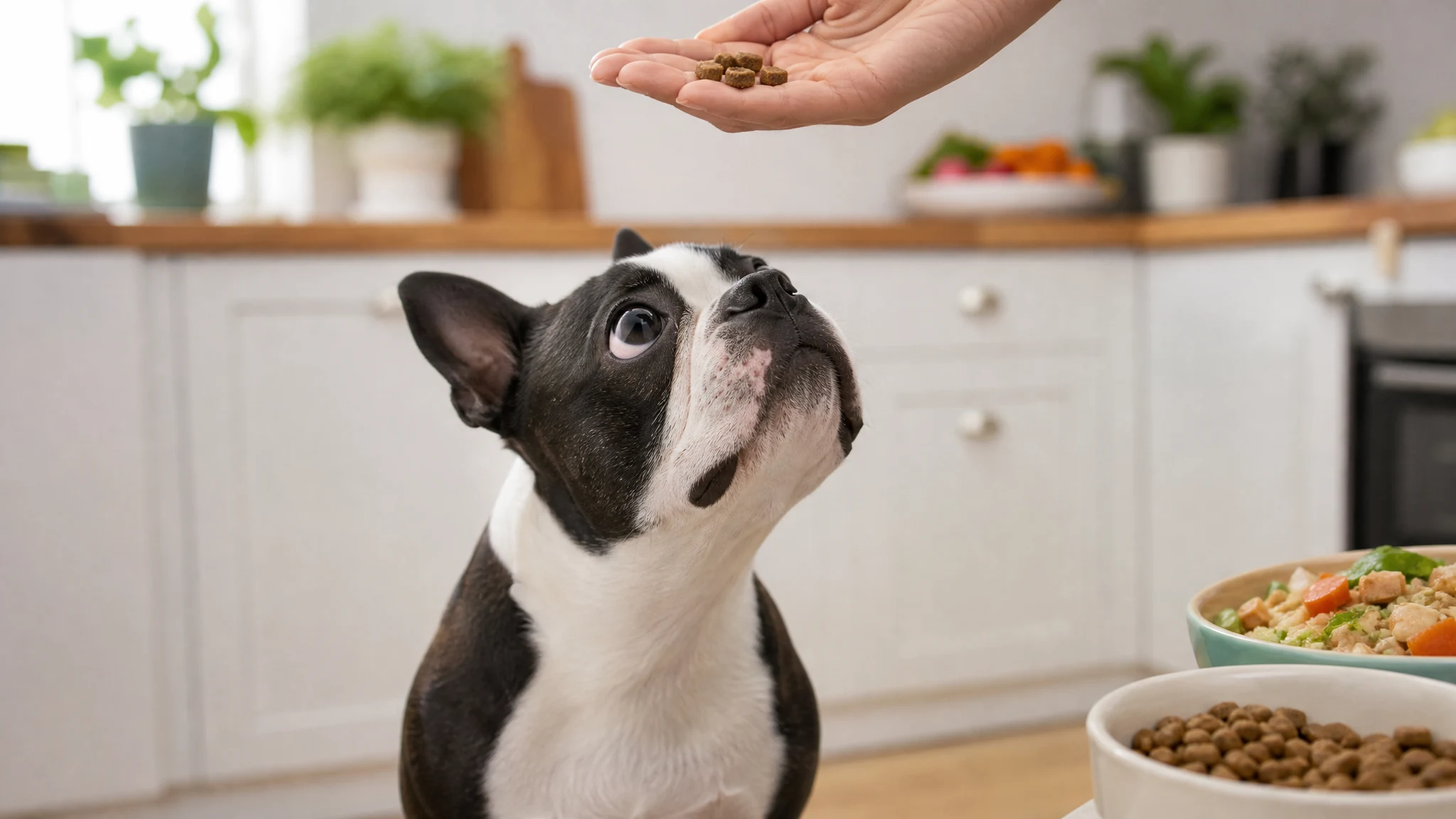
General nutrition information compiled from product labels and published sources, not veterinary advice. Your veterinarian is the right person to choose a diet for your dog, especially one with a health condition.
Training a Boston Terrier usually goes well with food rewards. The breed is small, and treats add up fast. A handful of the wrong treat can use up a big share of a day's calories.
This guide shows how to pick the best treats for Boston Terriers, how to size them, and how to count them against the daily food allowance. It covers categories of treats, not brands. Check each package label for the real numbers.
What You Need
- Your dog's regular food and its label feeding guide.
- Two or three treat types from different categories (see below).
- A kitchen scale or a measuring spoon.
- A treat pouch or small container.
- A calculator, or a phone, for one quick sum.
- The treat packages, so you can read the calories per treat or per piece.
Step 1: Know Your Dog's Daily Calorie Budget
Treats count as food. Before you pick any, find out roughly how much your dog eats each day.
Start with the label on the main food. As an example, Hill's Science Diet Adult Small & Mini Chicken & Brown Rice Recipe lists 357 kcal per cup. Its feeding guide suggests 1 1/3 cups a day for a 15 lb dog and 1 2/3 cups for a 20 lb dog. Those are label starting points, not rules for your dog.
The math for a 15 lb dog on that guide: 1 1/3 cups at 357 kcal is roughly 475 kcal a day. For a 20 lb dog, 1 2/3 cups comes to roughly 595 kcal a day.
Boston Terriers fall into AKC weight classes under 15 lb, 15 to under 20 lb, and 20 to 25 lb, according to Wikipedia's summary of the breed standard. So even a few extra bites matter.
If you feed a different food, use that label. Our label comparison of dog foods for Boston Terriers lists calories per cup for several foods side by side.
Step 2: Apply the 10 Percent Rule
A common guideline, often attributed to WSAVA calorie guidance, is to keep treats to about 10 percent of daily calories. The other 90 percent comes from a complete and balanced main food.
Using the examples above, 10 percent of roughly 475 kcal is about 48 kcal for the whole day. For roughly 595 kcal it is about 60 kcal. That is the total for every treat, chew and lick of something extra.
Your veterinarian can tell you if your individual dog needs a smaller allowance. Dogs that are overweight, or that have a medical condition, may need one.
Step 3: Choose a Treat Category
You do not need one perfect product. The best treats for Boston Terriers are the ones your dog values, that are small, and that fit the budget. Here are three categories worth knowing.
Soft training treats
These are made for training. They are soft, they smell strong, and many can be torn into tiny pieces without crumbling. That makes them handy for new skills where you reward often.
The catch is that calories vary a lot between products. Read the package for calories per treat and for the ingredient list.
Freeze-dried single protein treats
These are made from one meat, such as chicken. A short ingredient list makes it simple to avoid something your dog reacts to. They are light and easy to break up.
They are often high in value, so they work well for harder jobs like coming when called. Break them very small, because a whole piece can be a big portion for a small dog.
Vegetables
Many dogs will work for small pieces of plain vegetables such as cooked green beans or raw carrot. Offer them plain, with no salt, butter, onion or garlic.
Vegetables are usually the lowest-calorie option, so they suit easy repeats at home. Some dogs just do not care for them. If yours is one, keep them for low-stakes practice.
Step 4: Cut Treats to Boston Terrier Size
The treat should be about the size of a pea, or even smaller. Your dog should swallow it in a second and look back up at you.
Why so small? Training sessions can involve dozens of rewards. A 50-piece session with full-size treats could pass the whole daily treat budget in one sitting.
There is a second reason. Boston Terriers are a flat-faced breed. A Vet Times report on a PLOS One study found that 62.5 percent of 104 tested Boston Terriers had some grade of brachycephalic airway syndrome, though the breed was less severely affected than English or French Bulldogs. Keeping your dog at a lean weight is part of everyday care for breathing comfort, and your veterinarian can guide you on that.
Tiny pieces also mean less chewing. A fast gulp is easier to manage than a long crunch for a dog that already breathes noisily when excited.
Step 5: Count the Treats
- Read the calories per treat on the package. If it only lists calories per kilogram or per cup, ask the brand or check its own website.
- Work out how many calories are in one of your cut pieces. If one treat has 3 kcal and you cut it into thirds, each piece is about 1 kcal.
- Divide your daily treat budget by that number. A 48 kcal budget at 1 kcal a piece allows about 48 pieces.
- Count out that many pieces into a container each morning.
- When the container is empty, treats are done for the day.
If a day has a big training session, shrink the meals slightly to make room. Using the same example guideline, one brand's page tells owners who add wet food to cut the dry amount, and the same idea works for treats. Adjust gradually and watch your dog's weight and body shape.
Step 6: Train With Reward-Based Methods
Reward the behavior within a second or two, then hand over the treat low and near the nose. Keep sessions short, about five minutes, and end while your dog is still keen.
The American Veterinary Society of Animal Behavior (AVSAB) supports reward-based training. Avoid punishment, harsh corrections and dominance methods. They can raise stress and damage trust without teaching the behavior you want.
Mix in other rewards too. Praise, a toy or a game of tug can replace some food, which saves calories.
Tips for Better Results
- Use a ladder of value. Vegetables for easy tasks, soft treats for normal work, freeze-dried meat for hard ones.
- Read the whole label. Look at the ingredient list, the calories, and whether the package says it is a treat or a complete food.
- Introduce one new treat at a time. If your dog has loose stool or itching, you will know which food to question.
- Keep treats fresh. Soft treats can dry out in a pouch, and a dried-out treat is less exciting.
- Ask your veterinarian about skin concerns. Wikipedia lists atopic dermatitis and allergic skin disease among the breed's skin conditions. One fresh-food company, Nom Nom, says corn and soy are the main triggers in Boston Terriers and suggests an 8 week single-ingredient food trial. That is a company's view, not clinical evidence, so talk with a veterinarian before changing your dog's diet.
- Be calm about grain-free claims. The FDA's investigation into diets and canine dilated cardiomyopathy was last updated December 23, 2022, and the agency says adverse event reports alone do not establish causation. If a treat's marketing leans on being grain-free, treat that as a label feature to weigh, not proof of quality.
Common Mistakes to Avoid
- Treats that are too big. This is the most common mistake with small dogs.
- Not counting snacks outside training. Dental chews, table scraps and bits dropped in the kitchen all count.
- Choosing by the front of the bag. Words like "natural" or "premium" are marketing. The ingredient list and calorie statement tell you more.
- Switching everything at once. A new treat and a new food on the same day makes problems hard to trace.
- Using treats to fix everything. If a dog only listens when food is visible, start fading the lure and rewarding after the behavior instead.
- Forgetting the vet. A veterinarian decides what is right for an individual dog, especially with weight, allergy or health concerns.
What to Expect
With short sessions and quick rewards, many dogs may start to pick up simple cues, like sit, within a few days of regular practice. Harder skills usually take weeks. Every dog learns at a different pace.
Keeping treats within a set daily budget can help owners avoid creeping weight gain, though a dog's weight also depends on its main food, exercise and individual health. Weigh your dog on a regular schedule and tell your veterinarian if the trend changes.
How We Compared Things
We compared label information such as calories per cup, ingredient lists and feeding guides. We did not run feeding trials or taste tests, and we have not fed these products to dogs. The calorie examples above are simple arithmetic based on one brand's published label values. Use them as a starting point, then check your own food and treat labels.
Sources
- Hill's Pet Nutrition: Science Diet Adult Small & Mini Chicken & Brown Rice Recipe (dry)
- Vet Times: Boston Terrier brachycephaly analysis, 6 January 2025
- FDA Center for Veterinary Medicine: Investigation into Potential Link between Certain Diets and Canine Dilated Cardiomyopathy
- Wikipedia: Boston Terrier (breed weight classes and skin conditions)
- Nom Nom: Boston Terrier skin allergies article (company source)