Best Dog Food for Boston Terriers With Gas: What the Label Can Tell You
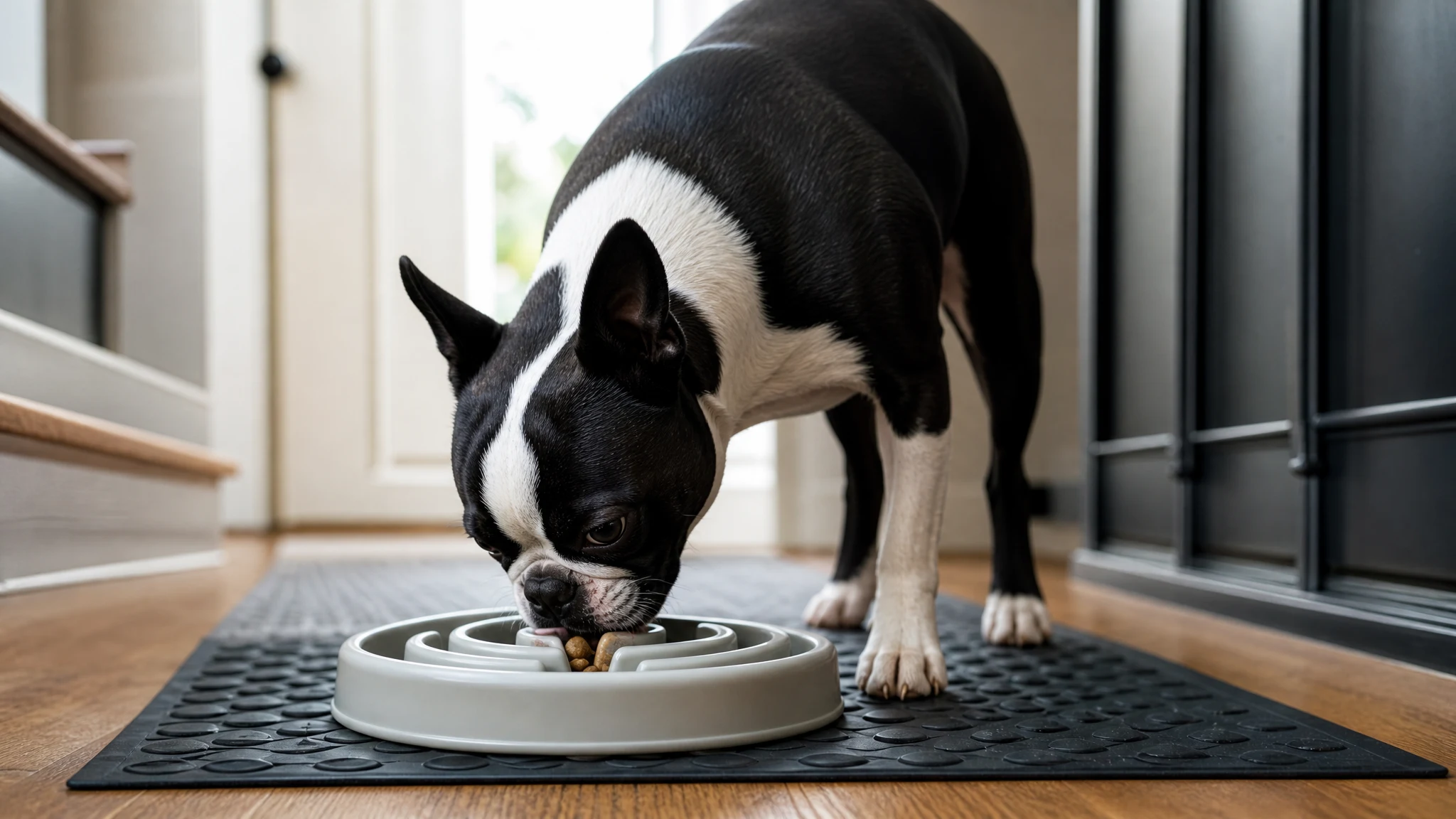
General nutrition information compiled from product labels and published sources, not veterinary advice. Your veterinarian is the right person to choose a diet for your dog, especially one with a health condition.
Gas is a common complaint from Boston Terrier owners. It is also easy to blame on the wrong thing. No bag of food is the single answer, and no label can promise a quieter dog.
What a label can do is help you compare foods in an organized way. This guide shows how to read the label, change one thing at a time and keep notes you can bring to your veterinarian. That is the practical way to look for the best dog food for Boston Terriers with gas.
First, a Few Honest Limits
We compared label data from manufacturer pages. We did not run feeding trials or taste tests, and we did not watch any dog eat these foods. Nothing here says a food will stop gas.
Gas can come from diet, but it can also point to something else. Persistent or painful gas, vomiting, diarrhea or weight loss belongs with a veterinarian, who decides what is right for an individual dog.
No brand we looked at makes a Boston Terrier-specific formula. The foods below are small-breed formulas. Boston Terriers are small, and Wikipedia, summarizing the AKC standard, lists adult weight classes of under 15 lb, 15 to under 20 lb, and 20 to 25 lb. That range fits small-breed foods such as those sold for dogs up to 25 lb.
What You Need
- The bag or can of your dog's current food, with the full label visible
- A notebook or phone notes app
- A measuring cup, or a kitchen scale if you prefer grams
- A list of every treat, chew and table scrap your dog gets
- Your veterinarian's contact details
Step 1: Rule Out Non-Food Causes With Your Veterinarian
Book a check first if the gas is new, severe or comes with other signs. Boston Terriers are a flat-faced (brachycephalic) breed. A Vet Times report on a PLOS One study found that 62.5 percent of 104 tested Boston Terriers had some grade of brachycephalic airway syndrome (BOAS), though the breed's cases were less severe than those in English or French Bulldogs.
We cannot tell you how airway shape relates to your dog's gas. That is a question for your veterinarian. Weight control matters for breathing in the breed, so ask whether your dog's current weight and portions are appropriate.
Step 2: Record What Your Dog Eats Now
Write down the brand, product name, life stage and daily amount. Include treats, dental chews and anything shared from your plate. For one to two weeks, note when gas happens, how strong it seems and what happened that day.
This record is the most useful thing you will make. It turns "he is gassy" into a pattern you and your veterinarian can look at.
Step 3: Read the Label Properly
Look at four parts of the label.
The AAFCO statement
This says whether the food is complete and balanced and for which life stage. For example, Royal Canin's Small Adult page says the food is formulated to meet AAFCO Dog Food Nutrient Profiles for maintenance. A puppy food should carry a growth statement. The AAFCO large-size threshold is 70 lb or more as an adult, according to Whole Dog Journal. Boston Terriers are well under that, so "except for large size dogs" wording does not matter for this breed.
The Merrick small-breed page we reviewed did not show an AAFCO statement. Check the bag itself or ask the brand.
The ingredient list
Ingredients are listed in order, and the first five give a rough picture. Here are the first five ingredients as shown on each brand's own page. Lists can change by bag, so confirm on yours.
| Food | First five ingredients |
|---|---|
| Royal Canin Small Adult (dry) | Corn, chicken by-product meal, brewers rice, brown rice, corn protein meal |
| Hill's Science Diet Adult Small & Mini Chicken & Brown Rice (dry) | Chicken, brown rice, whole grain wheat, whole grain corn, brewers rice |
| Merrick Kitchen Comforts Small Breed Chicken & Brown Rice (dry) | Chicken, chicken meal, brown rice, barley, oatmeal |
| Nom Nom Chicken Cuisine (fresh) | Chicken, sweet potatoes, squash, spinach, fish oil |
Do not assume an ingredient causes gas because it appears on a list. One fresh-food company, Nom Nom, says in an article on Boston Terrier skin allergies that corn and soy are the main triggers for itching and flatulence, and suggests an 8 week single-ingredient food trial. That is a commercial source, not clinical evidence. Treat it as one company's view and ask your veterinarian before trying any elimination diet.
The guaranteed analysis
Protein, fat and fiber numbers let you compare foods, but check the basis. Royal Canin lists minimums for protein (25 percent), fat (14 percent) and a fiber maximum (3.2 percent) for Small Adult. Hill's publishes average nutrient content on a dry matter basis instead. For Adult Small & Mini that is 25 percent protein, 15.3 percent fat and 1.5 percent fiber. Those are not the same kind of number, so do not line them up directly.
Calories per cup
Calories matter more than most owners expect. Royal Canin Small Adult lists 359 kcal per cup, Hill's Adult Small & Mini lists 357, and Merrick's small-breed recipe lists 467. A cup of one food is not a cup of another, so switching foods by volume can change calories a lot.
For a side-by-side view, see our label comparison of dog foods for Boston Terriers.
Step 4: Pick One Candidate and Use the Label's Feeding Guide as a Starting Point
Choose a food that matches your dog's life stage and size, and ask your veterinarian whether it suits your dog. Then use the feeding guide as a starting point, not a rule. For Hill's Adult Small & Mini, the page lists 1 1/3 cups (130 g) a day for a 15 lb dog and 1 2/3 cups (160 g) for a 20 lb dog. Royal Canin recommends 2 to 4 equal portions per day for Small Adult.
Your dog's body condition, activity and treats all change the right amount. Your veterinarian can help adjust it.
Step 5: Switch Gradually and Change One Thing at a Time
Mix a little of the new food into the old and increase it over several days. The exact schedule is a conversation for your veterinarian, since sensitive dogs differ. Do not add new treats, chews or toppers during the switch. If you change several things at once, you will not know which one mattered.
If you add wet food to dry, adjust the dry amount. Merrick's page, for example, says to reduce dry food by 1/2 cup for every 6 oz of wet food.
Step 6: Keep Notes and Review
Keep the same daily notes for several weeks. Compare them with your earlier record. Bring both to your veterinarian, who can tell you whether to stay with the food, try another or look into other causes.
Tips and Common Mistakes
- Judging a food by one bad day. Gas varies. Look at weeks, not hours.
- Trusting front-of-bag claims. Words like "sensitive" or "natural" are marketing. The AAFCO statement, ingredient list and calories are the facts to check.
- Switching foods too fast. A sudden change can upset digestion by itself.
- Ignoring treats. They can matter as much as the main food.
- Going grain-free by default. The FDA's investigation into diets and canine dilated cardiomyopathy (DCM) was last updated December 23, 2022, and FDA says adverse event reports alone do not establish causation. FDA does not plan more public updates until there is meaningful new science. Ask your veterinarian before choosing a diet on that basis.
- Starting an elimination diet alone. Ask your veterinarian first. Prescription diets are only something a veterinarian prescribes.
- Overfeeding. Extra weight is a concern in a breed with airway issues.
What Results to Expect
Some dogs may have less gas after a change in food, and some may not. Gas can also come from causes unrelated to the bowl. A careful record and a gradual switch simply give you and your veterinarian clearer information. No label can promise an outcome, and no food prevents, treats or cures a medical condition.
Sources
- Wikipedia: Boston Terrier (adult weight classes)
- Vet Times: Boston Terrier brachycephaly analysis
- Nom Nom: Boston Terrier skin allergies (commercial source)
- FDA: Investigation into potential link between certain diets and canine DCM
- Whole Dog Journal: large breed puppy food and AAFCO size groups
- Royal Canin Small Adult
- Hill's Science Diet Adult Small & Mini
- Merrick Kitchen Comforts Small Breed
- Nom Nom Chicken Cuisine