Can Boston Terriers Eat Chicken? Safe Ways to Serve It
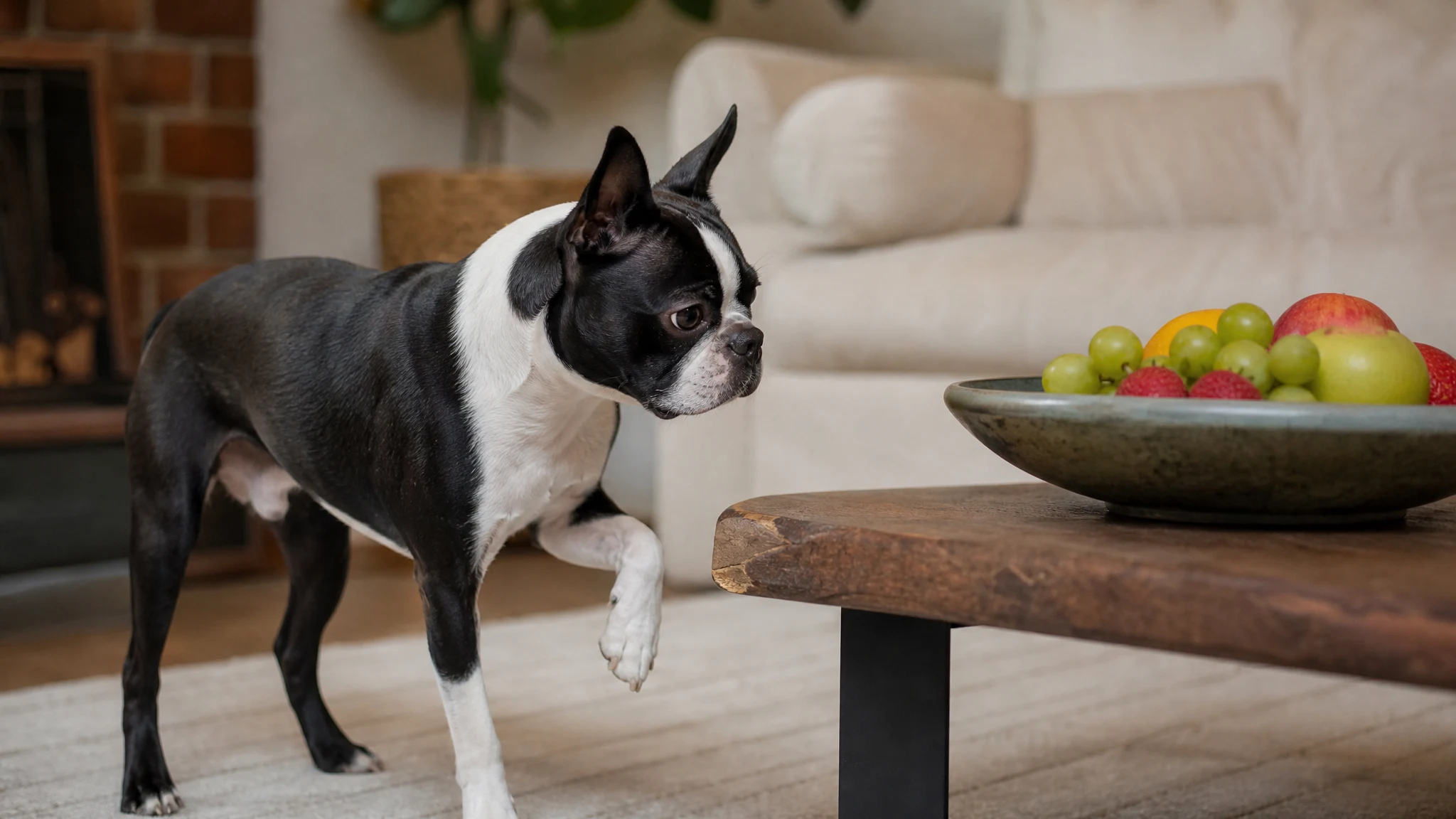
General nutrition information compiled from product labels and published sources, not veterinary advice. Your veterinarian is the right person to choose a diet for your dog, especially one with a health condition.
Short answer: yes, plain cooked chicken is a common food for dogs, and many Boston Terriers do well with it. The details matter, though. How you cook it, how much you give and what else is in the bowl all change whether it is a good idea for your dog.
This guide walks through the steps for serving chicken to a Boston Terrier. It also shows how to read chicken on a dog food label, where it often looks different from what you cook at home.
Why chicken needs a little extra thought for this breed
Boston Terriers are small. Wikipedia, summarizing the American Kennel Club standard, lists weight classes of under 15 lb, 15 lb up to 20 lb, and 20 lb up to 25 lb. A small body means small mistakes add up fast. A few extra bites of rich food can be a large share of a day's calories.
Weight also matters for breathing. A Vet Times report on a PLOS One study (January 2025) found that 62.5 percent of 104 tested Boston Terriers had some grade of brachycephalic airway syndrome, grades 1 to 3. The same report said the breed showed less severe signs than English or French Bulldogs. That does not mean chicken causes or prevents anything. It is a reason to keep treats modest and to talk with your veterinarian about a healthy weight for your dog.
What you need
- Plain chicken breast or thigh, fresh or thawed. Boneless and skinless is the simplest choice.
- A pot with water, or a pan you can use without oil.
- A clean cutting board and knife kept just for raw poultry, or one you wash well afterward.
- A kitchen scale or measuring spoons, so you can portion it.
- An airtight container for leftovers.
You do not need salt, oil, butter, garlic, onion or any seasoning. Leave them all out.
How to serve chicken to a Boston Terrier, step by step
Step 1: Check with your veterinarian first
This is especially worth doing if your dog has itchy skin, stomach upsets or a weight problem. Atopic dermatitis and allergic skin disease are listed among the breed's skin conditions on Wikipedia. One fresh dog food company, Nom Nom, says corn and soy are the main food triggers for the breed and suggests an 8 week single-ingredient food trial. That is a company's own article, not clinical evidence. If you suspect a food reaction, your veterinarian is the one to design any elimination diet.
Step 2: Start with raw, fresh chicken and handle it safely
Keep raw chicken away from other foods. Wash your hands, the board, the knife and the counter after you touch it. Do not rinse the meat in the sink, which can spread raw juices around.
Step 3: Remove skin, fat and every bone
Trim visible fat and take off the skin. Make sure no bones remain. Cooked bones can splinter, and a small dog has a small throat and a small stomach. Skin and fat are rich, and rich food is a common reason for loose stools.
Step 4: Cook it plain and all the way through
Boil or poach the chicken in plain water until no pink remains and the juices run clear. You can also bake it on a clean tray with no oil. Skip marinades, sauces, broth made with onion or garlic, and anything labeled seasoned or rotisserie. Store-bought cooked chicken often carries salt and flavorings, so check the ingredients before you share it.
Step 5: Cool, then cut into small pieces
Let it cool fully. Shred it or cut it into pieces that suit a small mouth. A Boston Terrier that gulps food can swallow big chunks too fast, so smaller is better. Flat-faced dogs often eat noisily and quickly, so watch your dog the first few times.
Step 6: Portion it as a treat or a topper
Count chicken as part of the daily food, not as an extra on top. Here is a way to think about it. Hill's Science Diet Adult Small & Mini Chicken & Brown Rice Recipe lists a starting guide of 1 cup (95 g) a day for a 10 lb dog, 1 1/3 cups for 15 lb, 1 2/3 cups for 20 lb and 2 cups for 25 lb. Those are label starting points for that food, not a rule for yours. If you add chicken, your dog likely needs a little less of the regular food. Ask your veterinarian how much to trim.
Merrick's page for its Kitchen Comforts Small Breed recipe gives similar advice for wet food. If you add wet food, it says to reduce the dry amount by 1/2 cup for every 6 oz of wet food. The same logic applies to anything you add to the bowl.
Step 7: Introduce it slowly
Offer a few small pieces on day one and watch your dog for the next day or two. Look at stool, itching, gas and appetite. If anything looks off, stop and call your veterinarian. Add more only if things stay normal.
Step 8: Store leftovers properly
Refrigerate cooked chicken in an airtight container soon after cooking. Throw out anything that has sat out for hours or smells wrong. Do not leave it in your dog's bowl.
Chicken on a dog food label is not the same as chicken in your pan
If you feed a commercial food, you are probably already giving chicken. The label tells you how. Here is what a few published labels show, as read from the brand pages.
| Food | First five ingredients | Calories |
|---|---|---|
| Royal Canin Small Adult (dry) | Corn, chicken by-product meal, brewers rice, brown rice, corn protein meal | 359 kcal ME per cup |
| Hill's Science Diet Adult Small & Mini Chicken & Brown Rice (dry) | Chicken, brown rice, whole grain wheat, whole grain corn, brewers rice | 357 kcal per cup |
| Merrick Kitchen Comforts Small Breed Chicken & Brown Rice (dry) | Chicken, chicken meal, brown rice, barley, oatmeal | 467 kcal per cup |
| Nom Nom Chicken Cuisine (fresh) | Chicken, sweet potatoes, squash, spinach, fish oil | 244 kcal per cup |
A few things stand out. Chicken may appear as whole chicken, chicken meal or chicken by-product meal, and the names mean different things on a label. Calories per cup also vary a lot, from 244 to 467 in this list, so a cup of one food is not a cup of another. Foods that look alike can feed very differently by volume.
Also note that none of these is made specifically for Boston Terriers. They are small-breed or all-size formulas. Hill's states its small and mini food is for dogs up to 25 lb full grown, which covers the breed's listed weight range. Royal Canin lists its Small Adult formula as meeting AAFCO nutrient levels for maintenance. For a side-by-side look at more foods, see our label comparison of dog foods for Boston Terriers. We compared label data only. We did not run feeding trials or taste tests.
One more note on grains. Hill's publishes average nutrient content on a dry matter basis, not as-fed minimums, so do not set those numbers beside another brand's guaranteed analysis. If a number matters to you, check the bag or ask the brand.
Tips and common mistakes
- Seasoned or deli chicken. Salt, garlic and onion powder are common in prepared chicken. Plain is the safe default.
- Cooked bones. Leave out drumstick and wing bones, even if the dog begs.
- Raw chicken. Raw poultry can carry germs that affect both dogs and the people handling it. If you are considering a raw diet, discuss it with your veterinarian first.
- Too much at once. A sudden big serving is a common cause of an upset stomach.
- Forgetting the calories. Small dogs gain weight easily. Adjust the regular meal when you add extras.
- Using chicken to manage a health problem. No food prevents, treats or cures a condition on its own. Diet questions about allergies, weight or the heart belong with your veterinarian. Prescription diets are something only a veterinarian prescribes.
- Making homemade chicken-and-rice the whole diet. Plain chicken is not complete and balanced by itself. A complete food carries an AAFCO statement on the label, such as the maintenance statements quoted by Royal Canin and Hill's.
About grain-free and heart concerns
You may see chicken foods marketed as grain-free. The FDA has investigated a potential link between certain diets and canine dilated cardiomyopathy. Its page was last updated on December 23, 2022, and says the agency does not plan further public updates until there is meaningful new scientific information. It also notes that adverse event reports alone do not establish causation. If this worries you, ask your veterinarian about your dog's diet instead of guessing from a bag.
What to expect
If your dog tolerates chicken, you may notice that it works well as a high-value reward for training, or as a small topper that makes a regular meal more appealing. Reward-based training pairs well with tiny pieces of plain chicken. Results vary from dog to dog. Some Boston Terriers have sensitive stomachs or skin, and some may react to chicken. Stop and contact your veterinarian if you see vomiting, diarrhea, constant scratching, swelling or trouble breathing.
For senior dogs, puppies or dogs with medical conditions, the right amount and type of food can differ. Hill's lists separate Small & Mini formulas for puppies, adults and dogs 7 and older. The brand page is the place to confirm current details, and your veterinarian is the one to decide what fits your dog.
The bottom line
So, can Boston Terriers eat chicken? In most cases, plain, boneless, fully cooked chicken in small portions is a reasonable choice. Keep it unseasoned, count it toward daily calories and introduce it slowly. Read your dog's food label too, since chicken may already be a main ingredient.
Sources
- Wikipedia: Boston Terrier (secondary source summarizing the AKC standard)
- Vet Times: Boston Terrier brachycephaly analysis, 6 January 2025
- Nom Nom: Boston Terrier skin allergies (commercial source)
- Nom Nom: Chicken Cuisine
- Hill's Science Diet Adult Small & Mini Chicken & Brown Rice Recipe
- Royal Canin Small Adult dry dog food
- Merrick Kitchen Comforts Small Breed Chicken & Brown Rice
- FDA CVM: Investigation into Potential Link between Certain Diets and Canine Dilated Cardiomyopathy