Can Boston Terriers Eat Rice? What It Does and Doesn't Help With
General nutrition information compiled from product labels and published sources, not veterinary advice. Your veterinarian is the right person to choose a diet for your dog, especially one with a health condition.
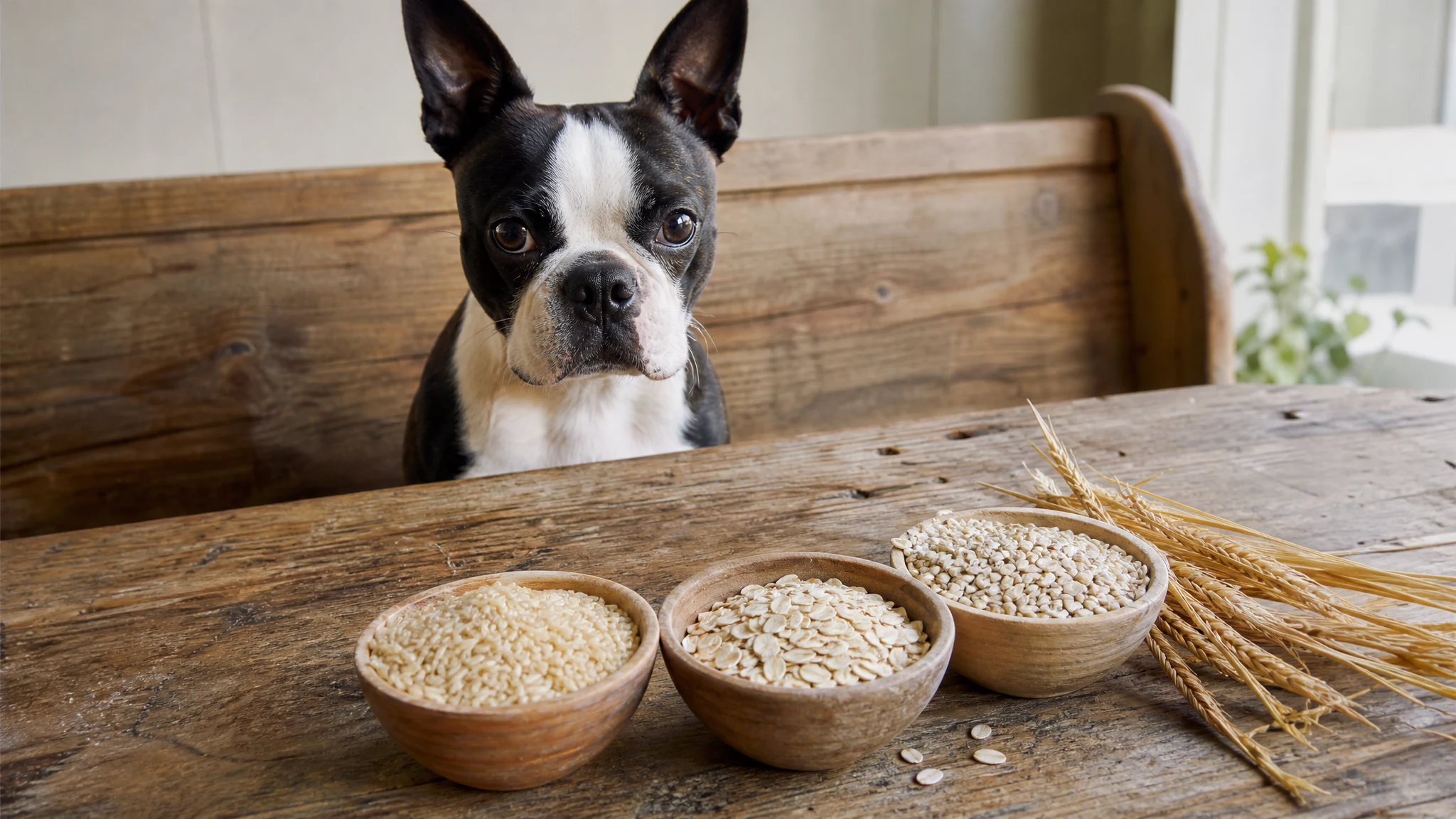
If you are wondering whether Boston Terriers can eat rice, the short answer is that rice is a common ingredient in dog foods made for small breeds. That is a statement about labels, not a promise about any one dog. This guide shows how to look at rice in your Boston Terrier's food, how to offer a little plain cooked rice if your veterinarian is comfortable with it, and what to expect.
One note on method. We compared label data published by the brands. We did not run feeding trials or taste tests, and nothing here replaces your veterinarian's advice about your dog.
Why rice comes up for Boston Terriers
Boston Terriers are small dogs. Wikipedia, summarizing the American Kennel Club standard, lists weight classes of under 15 lb, 15 lb up to 20 lb, and 20 lb up to 25 lb. Owners often ask about rice because it shows up so often in small-breed bags, and because the breed has a reputation for skin and stomach trouble.
Be careful with that second part. Wikipedia lists atopic dermatitis and allergic skin disease among the breed's skin conditions. One fresh dog food company, Nom Nom, says corn and soy are the main triggers for food allergy in the breed and suggests an 8 week single-ingredient food trial. That is a commercial source, not clinical evidence. If your dog itches or has gas, the right first step is a veterinarian visit, not a kitchen experiment.
What rice does and doesn't help with
Rice is a carbohydrate source. On a label, it is an ingredient that supplies energy and helps shape the kibble. That is about all a label can tell you.
- What it can do: add calories and bulk to a meal, and serve as a plain, simple topper that some dogs accept.
- What it does not do: prevent, treat or cure allergies, skin disease, breathing problems or any other condition. Rice is not a treatment.
- What it is not: a complete diet. Rice alone lacks what a dog needs. A food that carries an AAFCO statement of nutritional adequacy is the base of the diet.
Weight is the one diet topic with a clear link to this breed. Vet Times, reporting on a PLOS One study published in January 2025, found that 62.5 percent of 104 tested Boston Terriers had some grade of brachycephalic airway obstruction (grades 1 to 3). Boston Terriers showed less severe disease than English or French Bulldogs. The report does not say rice changes airway disease. It does mean extra calories are worth watching, and your veterinarian can tell you what a healthy weight looks like for your dog.
Materials you need
- Plain white or brown rice, cooked in water only.
- A measuring spoon or small cup, so the portion is the same each time.
- The food bag or can your dog already eats, with its feeding guide.
- A kitchen scale or measuring cup you already use for the main meal.
- Your veterinarian's phone number, in case your dog reacts badly.
Skip salt, butter, oil, garlic, onion, broth, sauces and seasoning. Plain means plain.
Step 1: Read the label on the food you already feed
Before you add rice, check whether the food already contains it. The brand pages show several examples of rice in small-breed dry foods:
- Royal Canin Small Adult (dry) lists corn, chicken by-product meal, brewers rice, brown rice and corn protein meal as its first five ingredients.
- Hill's Science Diet Adult Small & Mini Chicken & Brown Rice Recipe (dry) lists chicken, brown rice, whole grain wheat, whole grain corn and brewers rice.
- Merrick Kitchen Comforts Small Breed Recipe Real Chicken & Brown Rice (dry) lists chicken, chicken meal, brown rice, barley and oatmeal.
Ingredient lists can change by bag, so read the one you own. If rice is already near the top, a rice topper adds more of the same. That is one reason to keep it small.
For a wider look at how small-breed foods compare, see our label comparison of dog foods for Boston Terriers.
Step 2: Check the AAFCO statement
A complete food should say it is formulated to meet, or proven by feeding tests to meet, AAFCO nutrition standards for a life stage. For example, Royal Canin says its Small Adult is formulated to meet the AAFCO Dog Food Nutrient Profiles for maintenance. Hill's says feeding tests using AAFCO procedures substantiate its adult recipe for maintenance.
The Merrick page we reviewed did not show an adequacy statement. Check the bag or ask the brand before you rely on it as a main food.
Rice only belongs on top of a food like this, never in place of it.
Step 3: Set the daily food amount first
Start from the feeding guide and treat it as a starting point, not a rule. For example, Hill's lists 1 cup (95 g) per day for a 10 lb adult, 1 1/3 cups for 15 lb, 1 2/3 cups for 20 lb and 2 cups for 25 lb of its Adult Small & Mini dry food. Your dog's body condition and activity can change that, and your veterinarian is the one to adjust it.
Calories differ a lot between foods. Hill's lists 357 kcal per cup for that adult recipe. Merrick lists 467 kcal per cup for its small-breed recipe. A cup of one is not a cup of the other. Rice adds calories on top, so check the calorie count on the rice package and make room for it.
Step 4: Cook the rice plain and let it cool
- Rinse the rice, then cook it in plain water until soft.
- Do not add salt, fat or flavoring.
- Let it cool fully before serving. Hot rice can burn a small mouth.
- Store leftovers in the refrigerator and use them within a few days, or discard them.
Softer, well-cooked rice is easier to portion in small amounts. Brown rice has a firmer texture than white. Either is plain rice, and neither is a medicine.
Step 5: Add a small amount and trim the main meal
Ask your veterinarian how much is reasonable for your dog. We do not give a rice amount here because the right amount depends on your dog's weight, health and calorie needs.
In general, offer a spoonful or so at first rather than a bowlful. Then reduce the regular food a little so total calories stay steady. Merrick gives a similar idea on its page: if you add wet food, reduce the dry amount to compensate. The same logic applies to any topper.
Step 6: Watch your dog for a few days
Change one thing at a time. If you add rice and a new treat on the same day, you will not know which one caused trouble.
Watch for itching, loose stool, gas, vomiting, or a change in appetite or energy. Boston Terriers can be gassy, and the Nom Nom article lists flatulence with itching among food-allergy signs, though that is a company's claim. Stop the rice and call your veterinarian if anything looks off.
Tips and common mistakes
- Using rice as the main meal. It does not provide complete nutrition on its own.
- Forgetting the extra calories. Small dogs have small calorie budgets, and weight matters for this breed.
- Adding seasoning. Garlic, onion and heavy salt do not belong in a dog's bowl.
- Using rice to "fix" an ongoing problem. Repeated itching or stomach upset needs a veterinary exam. A veterinarian decides whether a diet change makes sense for an individual dog. Prescription diets are something only a veterinarian prescribes.
- Chasing marketing terms. "Grain-free" on a bag does not make a food better or worse for your dog by itself. The FDA's investigation into diets and canine dilated cardiomyopathy had its last public update on December 23, 2022. The FDA says adverse event reports alone do not establish causation, and that it does not plan more public updates until there is meaningful new scientific information. Ask your veterinarian about your dog's heart and diet rather than guessing.
- Assuming a breed formula exists. We did not find a Boston Terrier-specific formula from the brands we reviewed. The foods above are small-breed formulas. Hill's Adult Small & Mini is made for dogs up to 25 lb full grown, which covers the whole Boston Terrier weight range per the AKC classes above.
Puppies and seniors
Puppies need a growth food. Royal Canin Small Puppy and Hill's Puppy Small & Mini are examples of small-breed puppy foods. Boston Terriers are well under the 70 lb adult weight that AAFCO uses for its large-size dog category, so the "large-size" wording on puppy labels does not change the choice for this breed, according to Whole Dog Journal. We did not find a source for the age at which a Boston Terrier counts as an adult, so ask your veterinarian when to switch.
For older dogs, Hill's makes an Adult 7+ Small & Mini recipe. Wikipedia cites a 2024 UK study giving a life expectancy of 11.8 years for the breed, with other sources giving roughly 11 to 14 years. Ask your veterinarian how your senior dog's food and extras should change.
Expected results
If your Boston Terrier tolerates it, plain cooked rice may simply be a little extra something to mix into meals. Some dogs may like the texture. Others may not care.
Rice may not change itching, gas, skin condition or breathing. It is not known to prevent or treat any health problem, and results vary from dog to dog. If you are hoping for a specific health benefit, talk to your veterinarian instead.
Quick recap
- Read the label of your current food and check for rice.
- Confirm an AAFCO statement for the main food.
- Set the daily food amount from the feeding guide.
- Cook rice plain, in water only, and cool it.
- Add a small amount and trim the main meal.
- Watch for a few days and call your veterinarian about any concerns.
Sources
- Wikipedia: Boston Terrier
- Vet Times: Boston Terrier brachycephaly analysis, 6 January 2025
- Nom Nom: Boston Terriers and skin allergies (commercial source)
- FDA: Investigation into Potential Link between Certain Diets and Canine Dilated Cardiomyopathy
- Whole Dog Journal: large-breed puppy food and AAFCO wording
- Royal Canin: Small Adult (dry)
- Hill's Science Diet: Adult Small & Mini Chicken & Brown Rice Recipe
- Merrick: Kitchen Comforts Small Breed Recipe