Chicken and Rice Dog Food for Boston Terriers: Why It's a Common Sensitive-Stomach Choice
General nutrition information compiled from product labels and published sources, not veterinary advice. Your veterinarian is the right person to choose a diet for your dog, especially one with a health condition.
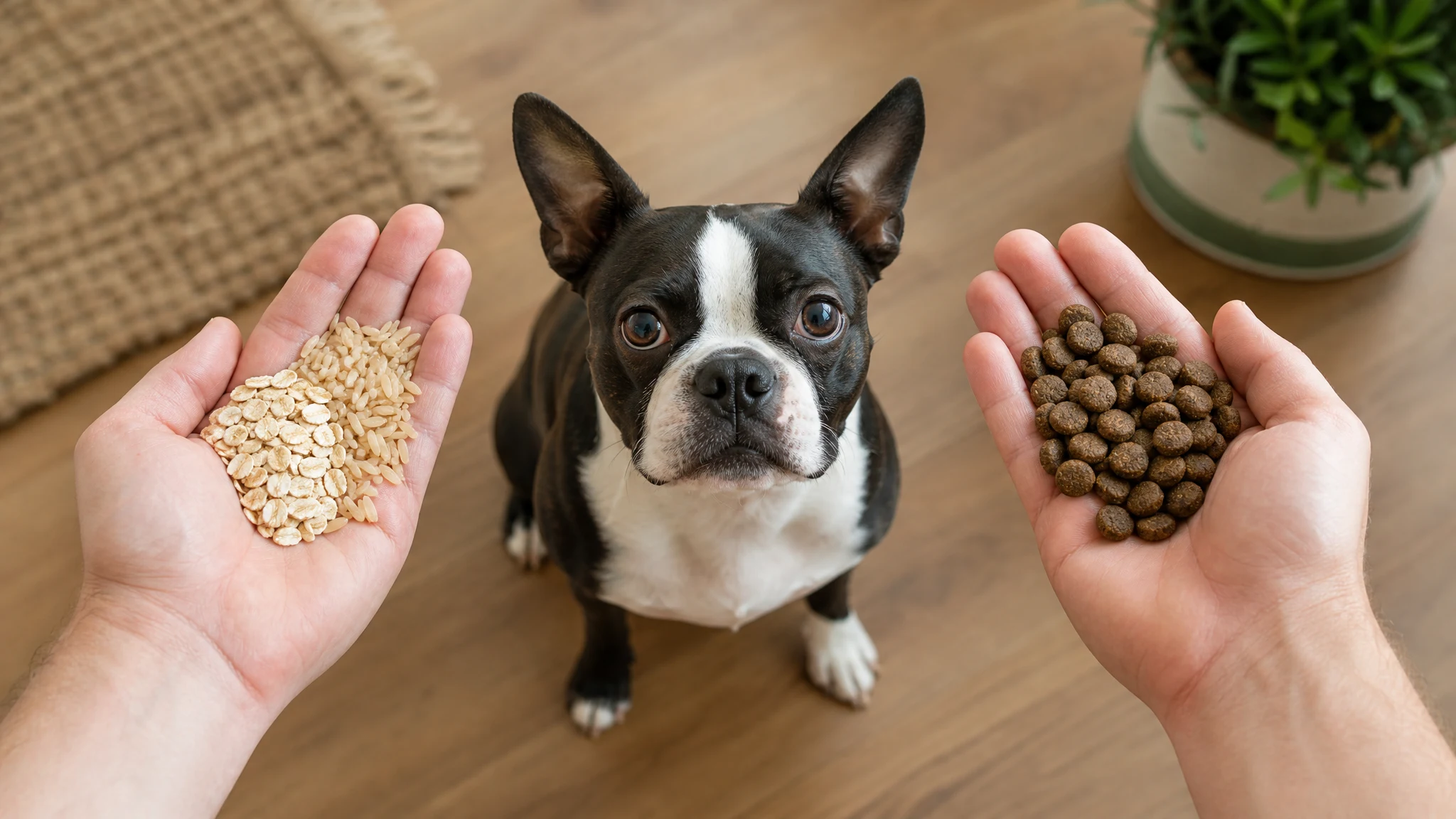
Chicken and rice is a familiar pairing on dog food bags. Many Boston Terrier owners reach for it when a dog seems to have a touchy stomach. This guide shows how to choose one, read its label, and switch over carefully.
One caution first. We found no breed source showing that chicken and rice helps a sensitive stomach. Its reputation comes mostly from habit and word of mouth. A veterinarian decides what is right for an individual dog, especially if there is vomiting, loose stool or itching.
Why this pairing is so common
Chicken is a widely used protein. Rice and brown rice are common, familiar grains. Together they make a plain-sounding recipe that owners find easy to understand.
Familiar is not the same as proven. A recipe can look simple and still include several other ingredients. Another recipe with a different main protein may suit your dog just as well. What matters is the whole label and how your own dog does on it.
Chicken can also be a problem for some dogs. One fresh-food company, Nom Nom, says corn and soy are the main triggers for Boston Terrier food allergies. That is a commercial claim, not clinical evidence. Its article recommends an 8 week single-ingredient food trial. Ask your veterinarian before running anything like that.
Why size and weight matter for this breed
Adult Boston Terriers fall into AKC weight classes of under 15 lb, 15 to under 20 lb, and 20 to 25 lb, according to Wikipedia's summary of the AKC standard. That puts them in small-breed food territory. No brand we checked makes a Boston Terrier-specific formula, so you are choosing a small-breed or all-sizes food.
Weight control also matters here. A 2025 Vet Times report on a PLOS One study found that 62.5 percent of 104 tested Boston Terriers had some grade of brachycephalic airway obstruction. Boston Terriers showed less severe signs than English or French Bulldogs. Keeping a dog lean is one reason to measure food carefully, and your veterinarian can advise on an ideal weight.
How we compared the foods
We compared label data published by each brand. We did not run feeding trials or taste tests, and we did not feed any of these foods to dogs. Ingredient lists can change by bag, so always check the bag in your hands. For a wider comparison, see our label-by-label comparison of dog foods for Boston Terriers.
What you need
- The bag or can label of your current food, for comparison
- The bag or brand page of the chicken and rice food you are considering
- A level measuring cup, or a kitchen scale for more accuracy
- A notebook or phone note to log meals, stool quality and itching
- Your veterinarian's contact details, and your dog's current weight
Step 1: Check with your veterinarian first
If your dog has ongoing stomach trouble, skin itching or weight changes, book a visit before changing food. These signs can have many causes that a food swap will not fix. Prescription diets are something only a veterinarian prescribes.
Ask whether chicken is a sensible protein for your dog and what target weight to feed toward. Take the label of the food you are considering.
Step 2: Match the food to your dog's life stage
Look for the AAFCO statement on the label. It should say the food is complete and balanced for your dog's stage: adult maintenance, growth, or all life stages.
Boston Terriers stay under 25 lb as adults. AAFCO's large-size threshold is 70 lb as an adult, so the wording about large-size dogs in growth statements does not matter for this breed, per Whole Dog Journal's explanation of the AAFCO rules.
We could not find a source for the age at which a Boston Terrier counts as an adult. Ask your veterinarian when to move from puppy to adult food.
Step 3: Read and compare the labels
Here are three chicken and rice style small-breed dry foods, using data published by each brand. The Hill's figures are average nutrient content on a dry matter basis. They are not as-fed label minimums, so do not compare them directly with Merrick's minimums.
| Food | First five ingredients | Nutrients | Calories |
|---|---|---|---|
| Hill's Science Diet Adult Small & Mini Chicken & Brown Rice | Chicken, brown rice, whole grain wheat, whole grain corn, brewers rice | Dry matter basis: protein 25%, fat 15.3%, fiber 1.5% | 357 kcal per cup |
| Hill's Science Diet Puppy Small & Mini Chicken & Brown Rice | Chicken, whole grain oats, brown rice, chicken meal, chicken fat | Dry matter basis: protein 28.9%, fat 19.7%, fiber 2.3% | 418 kcal per cup |
| Merrick Kitchen Comforts Small Breed Real Chicken & Brown Rice | Chicken, chicken meal, brown rice, barley, oatmeal | Minimums: protein 27%, fat 16%. Check the bag for the fiber maximum. | 467 kcal per cup |
A few things stand out. Merrick's page does not show an AAFCO adequacy statement that we could find, so confirm that on the bag or with Merrick. The Hill's Adult recipe says AAFCO feeding tests substantiate it for adult maintenance. For the Puppy recipe, read the full growth statement on the bag.
Neither of these is a plain "chicken and rice" food. Both include other grains. If you are watching for a specific ingredient, read the whole list, not just the name on the front.
Calories per cup vary a lot. Merrick lists 467 kcal per cup and Hill's Adult lists 357. The same scoop is a very different meal. Brand pages are the place to check the latest numbers: Hill's Science Diet Adult Small & Mini and Merrick Kitchen Comforts Small Breed.
Step 4: Work out a starting portion
Use the feeding guide as a starting point, not a target. For Hill's Adult Small & Mini, the brand's guide lists:
- 10 lb dog: 1 cup (95 g) per day
- 15 lb dog: 1 1/3 cups (130 g) per day
- 20 lb dog: 1 2/3 cups (160 g) per day
- 25 lb dog: 2 cups (190 g) per day
Merrick says that if you add wet food, you should reduce the dry amount by 1/2 cup for every 6 oz of wet food. Treats and toppers count too. Then adjust with your veterinarian's guidance based on your dog's body condition.
Step 5: Switch gradually
A common approach is to mix a little of the new food into the old, then raise the share of the new food over about a week. Some dogs need longer. Check the brand's own instructions on the bag, and follow your veterinarian if their advice differs.
- Start with mostly the old food and a small amount of the new.
- Increase the new food in steps every couple of days if stools stay normal.
- If stool softens, hold at the current mix for a few more days rather than rushing.
- Finish on the new food only, measured at the starting portion from Step 4.
Step 6: Track and adjust
For a few weeks, log meals, stool quality, itching and energy. Weigh your dog on a regular schedule if you can. Bring the notes to your veterinarian if anything worries you. Written records are far more useful than memory.
Tips and common mistakes
- Judging by the front of the bag. "Chicken and rice" on the front does not tell you the full ingredient list. Read the back.
- Comparing cups across brands. Compare calories per cup, then adjust the portion.
- Switching too fast. A sudden change can upset any dog's stomach, including one on a gentle recipe.
- Ignoring treats. Small dogs have small calorie budgets, and extras add up quickly.
- Changing several things at once. Swap one food at a time so you can tell what made the difference.
- Treating grain-free as a safer choice. The FDA's page on its investigation into diets and canine dilated cardiomyopathy says adverse event reports alone do not establish causation. Its last update was December 23, 2022, and it does not plan more updates without meaningful new science. Ask your veterinarian about this topic.
- Skipping the vet for itching. Wikipedia lists atopic dermatitis among the breed's skin conditions, and itching has many causes besides food.
What results to expect
Some owners notice firmer stools or less stomach upset after moving to a simple, gradual routine. Others see no change. A food cannot be said to treat or prevent a digestive or skin condition, and results vary from dog to dog.
Give any new food a few weeks, with the steady portions and records above, before judging it. If problems continue or worsen, stop experimenting and call your veterinarian.
Choosing the best chicken and rice dog food for Boston Terriers
The best chicken and rice dog food for Boston Terriers is the one that is complete and balanced for your dog's life stage, fits a small dog's calorie needs, and agrees with your individual dog. That is a label and observation question. It is not a ranking we can hand you.
Compare more options in our full Boston Terrier dog food comparison. For brand details we did not cover, such as kibble size, check with the brand directly.
Sources
- Hill's Science Diet Adult Small & Mini Chicken & Brown Rice Recipe
- Hill's Science Diet Puppy Small & Mini Chicken & Brown Rice Recipe
- Merrick Kitchen Comforts Small Breed Recipe Real Chicken & Brown Rice
- Vet Times: Boston Terrier brachycephaly analysis, 6 January 2025
- Wikipedia: Boston Terrier
- Whole Dog Journal: large breed puppy food and AAFCO wording
- Nom Nom: Boston Terriers and skin allergies (commercial source)
- FDA CVM: Investigation into potential link between certain diets and canine dilated cardiomyopathy